|
Getting your Trinity Audio player ready...
|
Investing in corporate bonds in India is not as simple as “lend money, earn fixed interest, and get principal back on maturity.” Many bonds in India, especially subordinated and perpetual debentures issued by large corporates and financial institutions, have embedded call options, and more recently, issues have contained put options as well.
If you have seen the phrase “call/put option” in an NCD prospectus and ignored it, this guide is for you. With the repo rate being held at 5.25% by the RBI for most of 2026, and SEBI actively changing the bond market regulations for retail participation, having an understanding of these clauses is a must. It impacts the reinvestment risk, expected return, and exit opportunities of an investor. This article will cover what call and put options are, where to spot them, and their impacts on a portfolio.
Start investing with just ₹10K & grow your wealth with fixed return opportunities.
Invest Now

What Are Call and Put Options in Corporate Bonds?
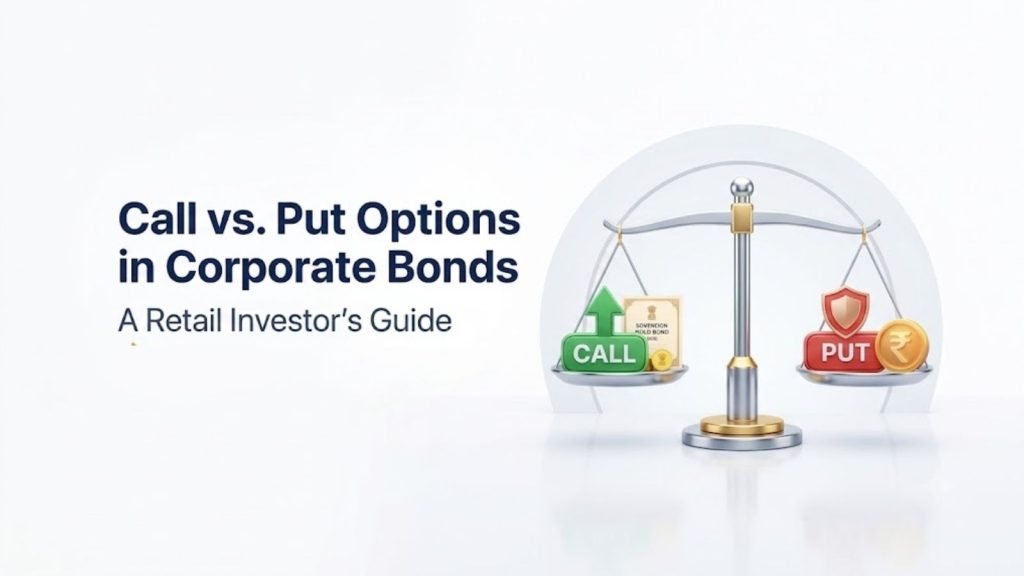
A corporate bond is a loan given to a company with the expectation of periodic interest payments and the full repayment of the principal at maturity. A call option or put option is an embedded clause that allows one of the parties to terminate the agreement before the bond’s maturity date.
- Call option: Gives the issuer the right (not obligation) to redeem the bond before maturity, usually on pre-specified “call dates,” often at par or a small premium.
- Put option: Gives the bondholder the right to sell the bond back to the issuer before maturity, typically also on set dates.
Think of it this way: a callable bond protects the company; a puttable bond protects you.
Why Do Indian Companies Issue Callable Bonds?
In India, call options are primarily found in subordinated and perpetual debentures issued by large corporates and NBFCs, both used to shore up capital rather than fund short-term working capital. Issuers add them mainly to manage interest rate and capital-cost risk. If the interest rates decline or if refinancing becomes cheaper, the company has the option to exercise the call option and redeem the bond early. ICICI Prudential Life Insurance is one such example where the company exercised the call option in 2025 to redeem ₹1,200 crore [1] of subordinated NCDs ahead of schedule.
Note: This and other issuer examples in this article are past, completed events cited for illustration only. They are not current offers, live investment products, or endorsements of any issuer or security.
For you as an investor, a callable bond usually means:
- Slightly higher coupon to compensate for “call risk”
- Uncertainty over your actual holding period
- Reinvestment risk: if called early, you may have to reinvest at lower prevailing rates
Why Do Put Options Matter for Retail Bondholders?
A put option works in your favor. If you’re worried about the issuer’s creditworthiness, rising rates elsewhere, or simply need liquidity, a put date lets you exit at a pre-agreed price without waiting for maturity or selling at a discount in a thin secondary market. This directly addresses a long-standing problem in Indian corporate bonds.
This is precisely why SEBI introduced the Liquidity Window Facility, effective November 1, 2024, allowing eligible investors to sell certain debt securities back to the issuer before maturity through a predefined put-option mechanism.
Call vs. Put Option: Key Differences
| Feature | Call Option | Put Option |
| Who benefits? | Issuer (company) | Bondholder (you) |
| Purpose | Refinance/manage capital cost | Exit early/manage liquidity. |
| Effect on coupon | Usually a higher coupon (compensates you for call risk) | Usually a slightly lower coupon (you’re paying for the safety net) |
| Main risk to investor | Reinvestment risk | The issuer may not always offer favorable exit pricing. |
| Typical Indian usage | Subordinated/perpetual NCDs (e.g., NBFCs, insurers, large corporates) | Increasingly offered via SEBI’s Liquidity Window (since Nov 2024) |
Latest Bond Updates:
- Fixed vs. Floating Rate NCDs: How Rate Cycles Impact Corporate Debt Returns

- Call vs. Put Options in Corporate Bonds: A Retail Investor’s Guide
- Bond Laddering in a Falling Rate Environment: A Guide for Indian Investors

How SEBI Is Reshaping India’s Corporate Bond Market
India’s corporate bond market reached 59 lakh crore by the end of FY26 [2], growing at a CAGR of approximately 12% in the last 10 years. In FY26, companies raised 9.1 lakh crore [2] through debt issuance, almost double the amount raised through equity issuance. Public NCD issuances, however, decreased from 19,168 crore in FY24 to 8,149 crore in FY25 [3], prompting SEBI to explore measures to revive retail participation in public debt issues.
Recent and proposed reforms include:
- The introduction of the Liquidity Window Facility with voluntary put options (November 2024 onwards)
- A consultation paper from 2025 proposing an increase in NCD issue coupons or pricing discounts to attract retail investors
- Enhanced disclosure norms, including risk-based classification, to help investors evaluate embedded options before investing
- Encouraging market participants to reissue existing bonds to reduce the number of fragmented and illiquid ISINs
- A pending August 2026 proposed revision to the Advertisement Code for OBPPs, which would introduce tighter restrictions on FOMO/urgency marketing and a mandatory “fixed returns” disclaimer; public comments accepted until September 11, 2026, and the final rules have not been issued yet.
How to Check If Your Bond Has a Call or Put Option
- Examine the key terms in the issue section of the prospectus/information memorandum; call/put dates are always disclosed upfront
- Effective yield tables may also be useful. Options typically only apply to specific bond series
- Look for the term “call/put option date” or “liquidity window” specifically
- Contact your debenture trustee or check the listing of your bond on the BSE/NSE debt segment for confirmation
Frequently Asked Questions
No. Call options can only be exercised on pre-specified call dates mentioned in the prospectus, not arbitrarily.
Not always at full value. Under SEBI’s Liquidity Window, the exit price can be up to 100 basis points below valuation.
They carry reinvestment risk rather than credit risk. You may need to redeploy proceeds at lower prevailing rates if called early.
Check the “Terms of the Issue” section of the prospectus or the bond’s listing disclosures on NSE/BSE.
They’re becoming more common since SEBI’s November 2024 circular, though issuers offer them voluntarily.
Investments in debt securities/municipal debt securities/securitized debt instruments are subject to risks, including delay and/or default in payment. Read all the offer/scheme-related documents carefully before investing.
Sources
- ICICI Prudential Life — NSE filing on interest/redemption
- CARE Ratings — Address by Tuhin Kanta Pandey, CareEdge Debt Summit, May 2026
- SEBI — Board Memorandum: Incentives in Public Issues
Disclaimer
Fixed returns do not constitute guaranteed or assured returns. Investments in corporate debt securities and municipal debt securities/securitized debt instruments are subject to credit risks, market risks, and default risks, including delay and/or default in payment. Read all the offer-related documents carefully. This blog/article should not be construed as financial advice or as an offer or recommendation to buy or sell any security or any products/services of/on GoldenPi or any product/services of its third-party client(s). For a detailed calculation of YTM, visit our website. T&C’s Apply.