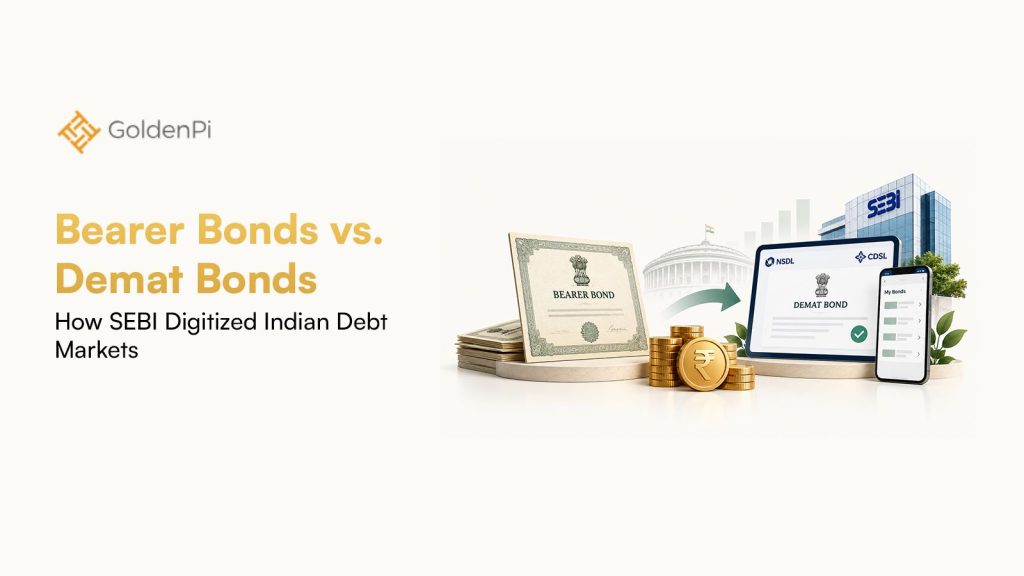
One reason why no one purchases paper bonds in India anymore is because of the introduction of dematerialization in the Indian capital markets. Bearer bonds, where possession of the bond meant ownership, were commonplace in India, from corporate debentures to even the government’s own Special Bearer Bonds. Now, they have been phased out, replaced by electronic versions held in a demat account.
This transformation did not happen overnight. It was the result of multiple regulatory pushes, spanning several decades, by SEBI, the Ministry of Corporate Affairs, and the depositories (NSDL and CDSL) to make the Indian debt markets safer, more transparent, and easier to trade on. For anyone wishing to understand the corporate bond and NCD market in India (worth approximately ₹59 lakh crore), it is important context, not just financial trivia.
Start investing with just ₹10K & grow your wealth with fixed return opportunities.
Invest Now

What Exactly Were Bearer Bonds?
A bearer bond was, quite literally, a bond that belonged to whoever held the physical certificate. There was no central record of ownership; the certificate was the proof. For a long time, companies issued bearer debentures, and interest was paid by physically detaching coupons from the certificate.
The government took this concept furthest with the Special Bearer Bonds Scheme of 1981, introduced through the Special Bearer Bonds (Immunities and Exemptions) Act. This scheme allowed people to exchange their black money for special bonds, which had several attributes, including anonymity and exemption from tax, in exchange for a 10-year lock-in. The scheme raised roughly ₹964 crore across two sale phases in 1981–82.
The obvious problem: anonymity is convenient for legitimate investors, but it is also convenient for money launderers, tax evaders, and people who won’t hesitate to use forged instruments. As the Indian financial system developed, bearer instruments became more and more inconsistent with the transparency regulators wanted.
From Paper to Pixels: How Dematerialization Changed the Game
Dematerialization (demat) is the process of substituting physical certificates with electronic records held in a depository account, much like money is held in a bank account instead of cash. India’s shift began with the Depositories Act, 1996, which created the legal framework for NSDL (and later CDSL) to hold securities electronically. Initially, the focus was on equity, but debt securities followed soon. The SEBI ILDS Regulations, 2008 (now part of the SEBI NCS Regulations, 2021), required public debt issuers to tie up with a registered depository before listing.
For corporate bonds, the practical effect has been significant:
- Bond ownership is now dematerialized and recorded in an electronic form with a depository, not tied to a physical certificate.
- Transfers are now non-physical and are completed much faster through depository participants.
- Interest and redemption payments flow directly to the registered holder; no coupon clipping, no risk of mutilated or lost certificates.
- KYC and PAN linkage are mandatory, closing the anonymity loophole bearer bonds relied on.
- Fraud and forgery have been reduced considerably because there is no physical document that can be copied or stolen.
SEBI and the MCA rolled out these changes over the 2010s and 2020s in stages, first to unlisted public companies, then to transfers of listed securities, and eventually to private companies, while also pushing the Electronic Book Provider (EBP) platform for private placements, so even large institutional bond deals are now originated and settled electronically end to end. The regulatory framework itself has kept evolving too: SEBI consolidated its debt-listing rules into a single NCS Master Circular in October 2025, replacing a patchwork of older circulars.
Bearer Bonds vs. Demat Bonds: A Side-by-Side Comparison
| Parameter | Bearer Bonds | Demat Bonds |
| Proof of ownership | Physical possession of the certificate | Electronic record with NSDL/CDSL via a demat account |
| Identity disclosure | Anonymous; no KYC required | Mandatory KYC and PAN linkage |
| Transfer process | Manual handover of paper | Electronic transfer via depository participant |
| Interest/coupon payment | Physical coupon clipping | Direct electronic credit to bank account |
| Risk of loss/fraud | High (theft, forgery, damage) | Comparatively low (centralized, auditable records) |
| Regulatory status in India | No longer issued in practice | Mandatory for listed and most unlisted/private debt securities |
| Traceability for AML/tax purposes | None | Full audit trail |
Note: the “risk” row above reflects operational and custody risk (the safety of holding and transferring the instrument), not investment or credit risk. A demat NCD carries the same issuer default risk as it would in any other form; dematerialization changes how safely you hold it, not whether the issuer will pay.
Latest Bond Updates:
- Mortgage-Backed Securities: How RMBS Work in India’s Debt Market

- Bearer Bonds vs. Demat Bonds: How India Digitized the Debt Market
- Premature FD Withdrawal: Penalties, Interest Calculation & Tax Impact

SEBI and MCA’s Key Regulatory Milestones
The move away from bearer and physical securities has been reinforced through a series of regulatory and legal changes rather than a single rule:
- 1996 – The Depositories Act, 1996, provided the legal framework for India’s depository system. NSDL, incorporated in December 1995, became India’s first depository and commenced operations in November 1996, helping establish the infrastructure for holding securities electronically.
- 2008 – SEBI’s Issue and Listing of Debt Securities (ILDS) Regulations established the regulatory framework for issuing and listing debt securities, including NCDs. The ILDS Regulations were subsequently merged with the NCRPS Regulations into the SEBI NCS Regulations, 2021, which came into force in August 2021.
- 2018-19 – MCA introduced Rule 9A, requiring unlisted public companies to facilitate dematerialization of their securities. Separately, SEBI’s Regulation 40 framework meant that, from April 1, 2019, transfers of listed securities held in physical form could be processed only after the securities were dematerialized.
- 2019 – SEBI’s large-corporate framework required specified large listed companies with long-term borrowings of ₹100 crore or more and an applicable credit rating of AA and above to raise 25% of their incremental borrowings through bonds, beginning April 1, 2019.
- 2023–24 – MCA introduced Rule 9B, extending mandatory dematerialization requirements to specified private companies, with small companies and certain other categories excluded. The original compliance deadline was September 30, 2024.
- 2025 – MCA subsequently extended the private-company dematerialization deadline to June 30, 2025. That deadline has since passed, and no further extension has been notified.
- 2024–25 – SEBI reduced the denomination of eligible debt securities from ₹1 lakh to ₹10,000, subject to specified conditions. The framework was subsequently modified in 2025, including to permit certain zero-coupon debt securities with a fixed maturity and without structured obligations to qualify for the reduced denomination.
Why This Matters for Bond Investors Today
India’s corporate bond market has more than tripled over the past decade, rising from around ₹17.5 lakh crore outstanding at the end of FY15 to ₹53.64 lakh crore [1] by March 2025. That represents a CAGR of roughly 12%. Corporate bond issuance during FY25 alone was about ₹9.95 lakh crore. That growth has continued into 2026: outstanding corporate bonds now stand at approximately ₹58–59 lakh crore [2], within a total Indian debt market (government, state, and corporate) that has crossed ₹240 lakh crore [3]. Operatively, none of this scale would be possible with a paper-based system. Demat infrastructure is what allowed online bond platforms (OBPPs), lower face values, and faster settlement to exist at all. these are features retail investors now take for granted.
For someone evaluating an NCD or a corporate bond today, the practical takeaway is simple: your bond holding sits in your demat account, is traceable, and has a significantly lower risk of custody fraud than the bearer bond era ever did. NITI Aayog [1] and credit rating agency CRISIL [4]projects the market could grow to ₹100–120 lakh crore by 2030, a projection, not a certainty, that depends heavily on this digital foundation holding up.
Bearer Bonds vs. Demat Bonds: Frequently Asked Questions
A bearer bond is a debt security where the person physically holding the bond certificate is treated as the holder. Historically, transfer could take place simply through delivery of the certificate.
With a bearer bond, possession was central to ownership. A registered bond, by contrast, recorded the holder’s name in the issuer’s records or a relevant register.
The physical certificate itself represented the holder’s claim. Losing the certificate, for example, could create significant ownership and recovery complications compared with an electronic holding.
A demat bond is a debt security held electronically in a dematerialized account rather than through a physical certificate.
Some eligible securities can still have physical holdings, depending on the applicable rules and issue terms. However, listed-market transfers and trading are generally structured around dematerialized holdings.
The physical certificate is surrendered through the prescribed dematerialization process, and the corresponding securities are credited electronically to the investor’s demat account.
Sources
- NITI Aayog – Deepening the Corporate Bond Market in India
- SEBI – Capital Markets: Engines of Growth
- GoldenPi – Secured and Unsecured Bonds in India
- CRISIL Ratings – Corporate bond market to more than double by fiscal 2030
Disclaimer
Fixed returns do not constitute guaranteed or assured returns. Investments in corporate debt securities and municipal debt securities/securitized debt instruments are subject to credit risks, market risks, and default risks, including delay and/or default in payment. Read all the offer-related documents carefully. This blog/article should not be construed as financial advice or as an offer or recommendation to buy or sell any security or any products/services of/on GoldenPi or any product/services of its third-party client(s). For a detailed calculation of YTM, visit our website. T&C’s Apply.