The Reserve Bank of India (RBI) holds significant influence over the Indian economy, particularly through its monetary policy decisions. Whether it’s controlling inflation, encouraging investment, or supporting growth, the RBI’s stance on interest rates can steer the economy in different directions. The RBI regularly adjusts its monetary policy to reflect the prevailing economic conditions, and the decisions made often lead to changes in the repo rate, which affects borrowing costs for individuals and businesses alike.
In its latest policy review announced on 7th October 2026, the RBI raised the repo rate* by 25 bps, or 0.25% to 5.50% from 5.25%. This marks the first rate hike since February 2023.
Think of the repo rate as the interest rate the RBI charges banks (like SBI, HDFC, or ICICI) when they need to borrow funds. When the RBI hikes this rate, those banks immediately pass the higher costs down to its customers, making loans more expensive for consumers.
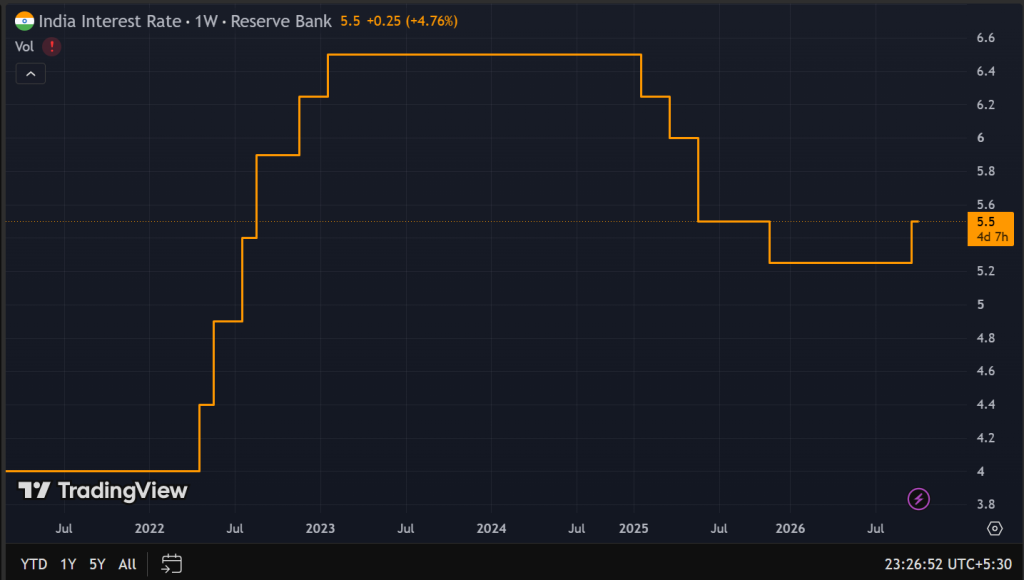
However, the rate hike itself was not the most significant part of the announcement, as it was already expected amid a weakening rupee and following interest rate hikes by some central banks, including the US Fed.
Start investing with just ₹10K & grow your wealth with fixed return opportunities.
Invest Now

The Real Signal: “Calibrated Tightening”
Along with the hike, the RBI changed its policy stance to calibrated tightening. This was done for the first time in 8 years; the last time it was done was in October 2018. This is what has shocked the markets.
In simple terms it means:
- At the next meeting, the RBI can either raise rates again or keep them unchanged.
- One option is firmly off the table: a rate cut.
If you were hoping that home loans and personal loans would get cheaper soon, that window has closed for now.
The Why: Prices are Rising and Spreading Fast
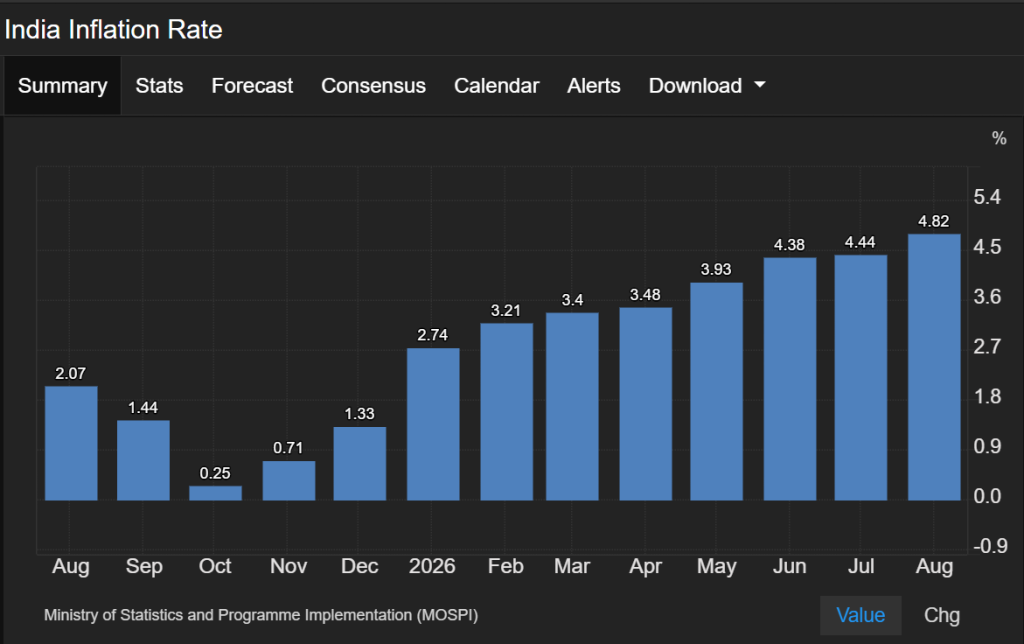
In August 2026, inflation climbed to 4.82%, marking the tenth consecutive month of an upward trend. As can be seen in the graph above, this is the third straight month that inflation has breached the RBI’s ideal 4% target. While the central bank maintains a flexible tolerance band between 2% and 6%, its ultimate goal is to firmly anchor inflation at 4%. Staying stuck above this ideal midpoint is exactly what forced the central bank to act.
Latest News from Bond Market –
- RBI Repo Rate Hike 2026: Bond Yields Surge to 7.24% as RBI Turns Hawkish
- Joint FD Rules: Either-or-Survivor vs. Former-or-Survivor & Tax Implications

- Beyond the Repo Rate Hike: What the RBI’s ‘Calibrated Tightening’ Means for Your Wallet

The real alarm bell isn’t just the main number, but how fast the heat is spreading across the “CPI basket”—which is just a fixed monthly shopping list of what a normal family buys, like food, housing, clothes, and fuel. A few months ago, price hikes were isolated to just a couple of items like vegetables and sugar. When spikes are confined like that, the RBI usually waits it out. Today, however, over a third (37%) of that entire household shopping cart is rising faster than 4%. When more than a third of the cart catches fire, it means price pressure is broadening, forcing the central bank to step in before it spins out of control.
The reasons for this are the West Asia conflict, soaring global crude prices, a weak southwest monsoon, and strong El Niño conditions.
The Positive Side Most People Miss
The RBI is not doing this because the economy is weak. In fact, it raised its growth forecast for the year to 40 bps, or 0.40% to 7.1% from earlier 6.7%. This is a measured step to cool inflation without slowing the economy too much.
How This Affects Different People
1. For consumers
Borrowing costs could go up slightly. Home loans, car loans, and other personal loans may become a little more expensive.
For example, If you take a ₹50 lakh home loan at 8% interest for 20 years, the monthly EMI rises from roughly ₹41,800 to about ₹42,600. That’s an extra ₹800 every month, or nearly ₹10,000 more over a year, for the same loan. And with rate cuts now off the table, relief on EMIs is unlikely anytime soon.
2. For businesses (especially retailers and MSMEs)
Higher interest rates mean a little more pressure on working capital—at a time when inventory levels are generally higher ahead of the festive season.
3. For savers
This could be positive. Banks may start offering better interest rates on fixed deposits and savings accounts in the coming weeks, and with the RBI signaling tightening, those higher rates may not reverse quickly.
4. Impact on Bond Yields (G-Secs & Corporate Bonds)
When the RBI raises rates, bond yields usually move higher.
Government Securities (G-Secs): Yields tend to rise across all tenures, especially for shorter tenures. Existing bonds become less attractive compared to new ones issued at higher rates, so their prices fall.
| Govt Securities | 7th Oct 2026 (After RBI MPC Meet) | 30th Sept 2026 (Before MPC Meet) |
| 091 D T-bill | 5.56% | 5.49% |
| 182 D T-bill | 6.06% | 5.94% |
| 364 D T- bill | 6.26% | 6.17% |
Corporate Bonds: These are priced based on government bond yields plus an extra risk fee. As government bond yields rise, corporate bond yields also move up. This means companies will have to pay more to borrow money from the market.
Consequently, current bondholders may experience capital losses; however, this environment simultaneously creates fresh avenues for investors to lock in higher-yielding new bond issuances.
5. Impact on Debt Mutual Funds
The effect on debt funds depends heavily on the duration of the fund. Duration is the average time when an investor will recover his initial investment.
| Type of Debt Fund | Likely Impact | Why it happens |
| Liquid / Overnight / Money Market | Positive or neutral | These funds quickly reinvest in higher-yielding papers |
| Short Duration / Low Duration | Mild positive to neutral | Limited interest rate risk |
| Medium to Long Duration | Negative (mark-to-market losses) | Bond prices fall when yields rise |
| Gilt Funds (especially long-duration) | Most negative | Highest sensitivity to interest rate changes |
Key takeaway: In a rising rate environment, shorter-duration funds are generally safer. Long-duration funds can see temporary declines in NAV even if the underlying credit quality is good. With the RBI now in “calibrated tightening” mode, this caution is likely to stay relevant for a while.
Latest FD Interest Rates:
- SBI FD Interest Rates in Oct 2026: Latest Rates, Features, and Things Investors Should Know
- HDFC Bank Fixed Deposits (FDs) and Interest Rates for October 2026
- ₹2 Crore FD Interest Per Month in 2026: FD vs Bonds vs Debt Funds
- Premature FD Withdrawal: Penalties, Interest Calculation & Tax Impact
- Where to Invest ₹1 Lakh in Fixed Income in 2026: A Practical Guide
6. Impact on Equity Markets:
Higher interest rates usually put some pressure on stock prices, especially on companies that are sensitive to rates—such as real estate, automobiles, NBFCs, and high-valuation growth stocks.
Investors value a company by what it will earn in the future, adjusted for today’s interest rates. When rates rise, those future earnings are worth less today.
Example: ₹100 of earnings expected five years from now is worth about ₹62 today at a 10% discount rate. At 11%, it is worth about ₹59. Companies whose earnings are far in the future, or whose valuations are already rich, feel this the most. Expect near-term pressure on such stocks, even though the 7.1% growth story hasn’t gone anywhere.
(Note: This simplified, hypothetical example illustrates how rising interest rates reduce the present value of future corporate earnings.)
Bottom Line
A 0.25% hike may sound small on paper. But the real message of this policy is the shift to “calibrated tightening”: rate cuts are now off the table, and further hikes remain possible if inflation keeps spreading across the CPI basket.
The decision was taken in a meeting room in Mumbai, but its effect lands directly in your personal finances – whether you’re a borrower, a saver, a business owner or an investor. Borrowers should plan EMIs for a higher-rate period instead of waiting for relief. Savers may see deposit rates firm up in the coming weeks. Debt fund investors may prefer shorter-duration funds for now. Equity investors should expect pressure on rate-sensitive and richly valued stocks.
The RBI is trying to keep prices under control while protecting India’s growth. For now, that means higher rates, potentially better returns for savers, some pressure on longer-term bonds, and a clear signal that cheaper loans are not coming anytime soon.
RBI Repo Rate Hike Frequently Asked Questions
Repo rate is the interest rate the RBI charges commercial banks to borrow short-term money. When it rises, banks raise their own lending rates, making home, car, and personal loans more expensive for you.
A- Accommodative: The RBI aims to drop interest rates to pump money into the system and boost economic growth.
B – Neutral: The RBI can move interest rates up, down, or keep them steady based on incoming inflation and growth data.
C – Withdrawal of Accommodation: The RBI is actively reducing money supply and raising rates to tame high inflation.
D – Calibrated Tightening: The RBI will only raise rates or keep them unchanged; rate cuts are completely off the table.
The RBI MPC meets six times a year (bi-monthly). Its main roles are to fix the repo rate, keep inflation anchored to the ideal 4% target, and support stable economic growth.
Borrowers: Monthly EMIs go up and retail loans get pricier.
Savers: Fixed Deposit (FD) and savings account interest rates increase.
Investors: Long-term debt mutual funds and stock markets face temporary downward pressure.
Disclaimer
Fixed returns do not constitute guaranteed or assured returns. Investments in corporate debt securities and municipal debt securities/securitized debt instruments are subject to credit risks, market risks, and default risks, including delay and/or default in payment. Read all the offer-related documents carefully. This blog/article should not be construed as financial advice or as an offer or recommendation to buy or sell any security or any products/services of/on GoldenPi or any product/services of its third-party client(s). For a detailed calculation of YTM, visit our website. T&C’s Apply.