Every year, a lot of Indians automatically opt for a bank fixed deposit when they’ve got some extra cash to invest, and for good reason: it’s familiar, safe, and easy. But here’s the thing: “safe” and “optimal” are not exactly the same thing. If you’ve got ₹1 lakh to allocate in 2026, there are more credible fixed-income options out there than most investors realize, like post office schemes that are paying over 8%, or debt mutual funds (that may have lost their old tax advantages but still have their uses), or the fast-growing bond market that’s now accessible through SEBI-regulated online platforms, which is no less than a game changer.
The best choice isn’t necessarily the one with the highest headline rate; it’s the one that’s actually tailored to your specific situation, like your holding period, your tax slab, and how much liquidity you need. With the RBI holding the policy repo rate at 5.25% after major cuts through 2025, deposit rates are already starting to drift downwards, which makes now a pretty good time to start thinking about what actually works for you, rather than just going with what you’re used to out of habit.
Start investing with just ₹10K & grow your wealth with fixed return opportunities.
Invest Now

Why the Repo Rate Cycle Changes Your FD Math
When the RBI decides to cut rates, banks usually follow. It just takes a quarter or two for deposit rates to catch up, but they do indeed move. And this isn’t just theory anymore: with the RBI keeping the repo rate steady at 5.25% for three policy reviews in a row this year, SBI’s general fixed deposit rate for 1-3 year deposits has already dipped to around 6.25%-6.40%. That’s a significant drop from the roughly 7% many banks were offering when the rate-cutting cycle first started. The takeaway here isn’t that you should steer clear of fixed deposits altogether; it’s smarter to spread them out across different tenures instead of locking, say, ₹1 lakh into a single rate.
Bank Fixed Deposits: Still the Default, But Know the Limits
FDs remain the most-used fixed-income product in India because they’re simple and DICGC-insured up to ₹5 lakh per depositor per bank. But rates vary meaningfully by bank type, and interest is fully taxable at your slab rate (with TDS deducted if interest exceeds ₹50,000 a year, ₹100,000 for senior citizens).
| Bank category | Indicative general-citizen rate (1–3 yr band) | Senior citizen rate |
| SBI | 6.25%–6.40% | 6.75%–6.90% |
| HDFC / ICICI / Axis Bank | 6.25%–6.45% | 6.75%–6.95% |
| IDFC FIRST Bank (highest among major private banks) | 6.50%–7.40% | 7.00%–7.90% |
| Post Office Time Deposit (5-yr) | 7.50% | Same (no separate senior slab) |
| Small Finance Banks (Suryoday, Utkarsh, Jana) | 8.00%–8.10% | Up to 8.30% |
Sources: Respective banks, India Post
Note: Rates as of early September 2026. Rates vary by tenure and change frequently. Always confirm the bank’s current card rate before booking.
Small finance bank FDs carry the same DICGC cover, but the higher rate reflects a marginally different risk profile. Spread your ₹1 lakh across two or three issuers rather than concentrating it in one, even within the insured limit.
Post Office Savings Schemes 2026: Interest Rates & Tax Benefits Compared
These are sovereign-backed and reset quarterly by the Finance Ministry. For the July–September 2026 quarter, rates on small savings schemes remained unchanged from the previous quarter, with SCSS and SSY unchanged at 8.2% and PPF at 7.1%.
- SCSS (8.2%): For investors 60+; quarterly payout, up to ₹30 lakh per individual
- PPF (7.1%): Fully tax-free (EEE status), 15-year lock-in, best for long-horizon money
- SSY (8.2%): Only for a girl child’s account, tax-free, long lock-in
- NSC (7.7%): 5-year lock-in, interest is taxable but qualifies for 80C reinvestment
- POMIS (7.4%): Monthly income, no tax-free status
The catch most people miss: PPF’s 7.1% headline looks lower than a bank FD, but because it’s tax-free, the post-tax return for anyone in the 20% or 30% slab is actually higher than most FDs.
Latest Fixed Deposit Updates:
- Beyond the Rupee: Decoding SEBI’s ‘Second Shelf’ for Global Bonds
- G-Sec STRIPS Explained: Zero-Coupon Sovereign Paper for Retail
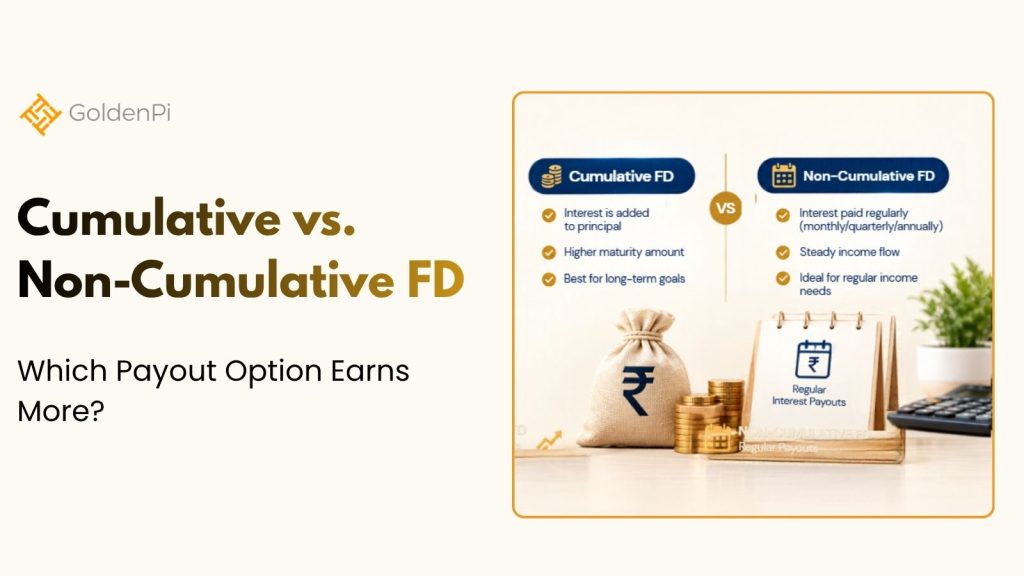
- Cumulative vs Non-Cumulative FD: Which Payout Option Earns More?
Debt Mutual Fund Taxation 2026: Are They Still Worth Investing In?
Up until 2023, debt funds had a sweet deal: hold them for over three years, and you’d get LTCG treatment with indexation, giving them a definitive edge over fixed deposits. But not anymore. The Finance Bill 2023 introduced some changes, and now investors in debt mutual funds don’t get that long-term capital gains tax perk. They’re taxed like bank deposits. For any units bought on or after April 1, 2023, gains are taxed at your regular slab rate, regardless of how long you hold them.
So why use them at all? Liquidity (no lock-in, redeem anytime), no TDS on redemption (unlike FDs), and access to target-maturity/G-Sec funds that mirror bond yields without the demat hassle. They’re a cash-management tool now, not a tax-arbitrage tool.
Bond Investing for Retail Investors: Types of Bonds & How to Buy Them in India
Direct bonds sit between FDs and equities on the risk spectrum, and India’s retail bond market has genuinely opened up in the last few years.
Types worth knowing:
- G-Secs and SDLs: sovereign/state-backed, accessible free of cost via RBI Retail Direct
- AAA-rated PSU bonds: near-sovereign safety, marginally higher yield than G-Secs
- Corporate bonds/NCDs: higher yield, but credit-rating dependent; check ratings before buying
- Legacy tax-free bonds (older REC/NHAI/PFC issues still trading): tax-exempt interest, limited secondary-market supply
- AT1/perpetual bonds: higher risk, generally not suited to a conservative ₹1 lakh allocation
OBPPs as the access route: SEBI formalized the registration and regulatory framework for Online Bond Platform Providers back in November 2022, requiring these platforms to register as stock brokers in the debt segment of recognized exchanges. In practical terms, this translates to platforms like GoldenPi allowing you to purchase listed corporate and PSU bonds with a low minimum investment of just ₹10,000.
You get all the crucial details upfront, like credit ratings, yield, and maturity data. On the other hand, you’ve got RBI Retail Direct, which is free but limited to sovereign paper, like G-Secs, SDLs, and T-bills, all bought directly from the RBI. If you’re looking for pure sovereign exposure, Retail Direct is the way to go; but if you’re after PSU or rated corporate paper with a slightly higher yield, an OBPP is your best bet.
Building Your ₹1 Lakh: A Sample Structure
There’s no universal split, but here’s an illustrative one for a moderately conservative investor with a 3-year horizon: ₹40,000 in a laddered bank/post office FD (liquidity + safety), ₹30,000 in SCSS or PPF depending on eligibility (tax efficiency), ₹20,000 in an AAA-rated PSU bond via an OBPP (yield pickup), and ₹10,000 in a liquid/overnight debt fund (emergency buffer). The exact split should shift with your tax slab and how soon you’ll need the money back.
The larger point: fixed income in India isn’t just about fixed deposits anymore. It’s more like having a whole toolkit at your disposal. You match each tool to the job at hand, and suddenly your ₹1 lakh is working way harder, all without diving into equity-like risks.
Invest ₹1 Lakh in Fixed Income: Frequently Asked Questions
Yes. A ₹1 lakh allocation can be spread across different instruments and maturities instead of being placed entirely in one product.
The risk differs by product. Bank deposits have DICGC insurance within the applicable ₹5 lakh limit per depositor per bank, while certain government securities and Post Office schemes carry sovereign backing. Each product still has different liquidity, tax, and interest-rate characteristics.
Online Bond Platform Providers (OBPPs) are platforms operating under SEBI’s regulatory framework that allow investors to access eligible debt securities. SEBI’s framework requires an OBPP to register as a stockbroker in the debt segment of a recognized stock exchange.
RBI Retail Direct provides retail investors access to government securities such as G-Secs, Treasury Bills, and SDLs. OBPPs provide access to eligible debt securities offered through their regulated platform framework, including listed corporate debt.
Check the investment horizon, expected post-tax return, credit risk, liquidity, lock-in, premature-exit rules, taxation, and whether the product matches the purpose for which the money is being set aside.
Disclaimer
Fixed returns do not constitute guaranteed or assured returns. Investments in corporate debt securities and municipal debt securities/securitized debt instruments are subject to credit risks, market risks, and default risks, including delay and/or default in payment. Read all the offer-related documents carefully. This blog/article should not be construed as financial advice or as an offer or recommendation to buy or sell any security or any products/services of/on GoldenPi or any product/services of its third-party client(s). For a detailed calculation of YTM, visit our website. T&C’s Apply.