
If you track India’s debt market, Maharajah bonds are suddenly hard to miss. On 19 October 2026, the Central Board of Direct Taxes (CBDT) notified that interest on the New Development Bank’s (NDB) Maharajah rupee bonds will no longer attract TDS from the 2026-27 tax year. That came weeks after the insurance regulator cleared these bonds for insurers. So what exactly are Maharajah bonds, and why do multilaterals like the NDB and the International Finance Corporation (IFC) issue rupee debt in India? This guide explains how they work, how they differ from Masala Bonds, and what they mean for Indian investors.
Start investing with just ₹10K & grow your wealth with fixed return opportunities.
Invest Now

What Are Maharajah Bonds, and How Do They Differ From Masala Bonds
Maharajah bonds are rupee-denominated bonds issued in India’s domestic market by a foreign or multilateral issuer. The issuer is global, but the bond is an Indian-market instrument. It is priced and settled in rupees, listed on an Indian exchange such as the NSE, and governed by domestic rules.
IFC’s 2014 debut Maharajah Bond issuance [1] was described as India’s first international AAA-rated issuance. It came in four tranches, including 5-year and 10-year bullet bonds and two separately tradable redeemable principal parts (STRPPs) maturing in 13 to 20 years. That range of maturities, from five years to as long as twenty, let IFC reach investors with different time horizons, and officials pitched the programme as a safe option for domestic pension funds. For an Indian institution, it feels like any other corporate bond, except the issuer is a global development lender.
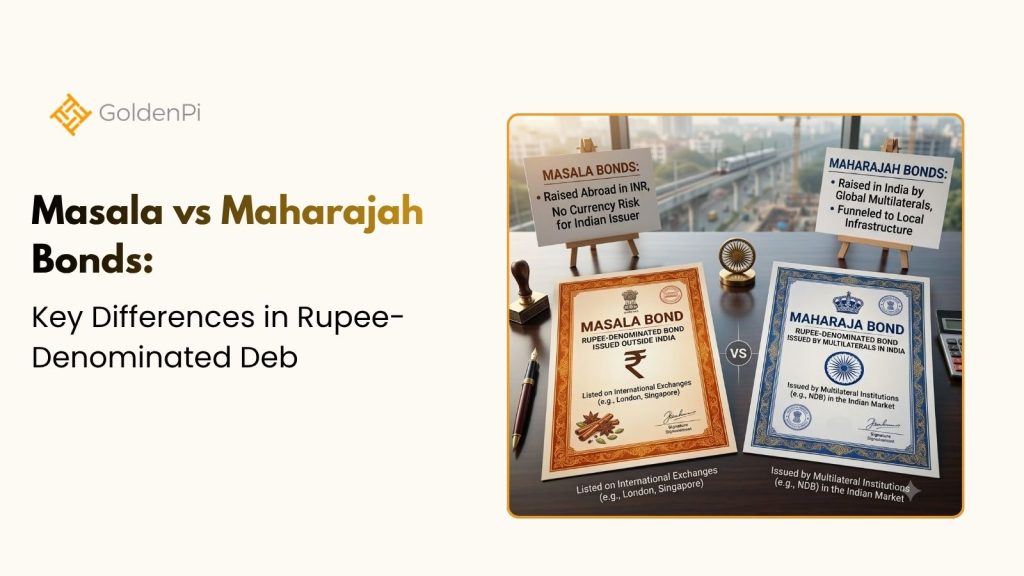
Now to the term that often gets confused with it. Masala bonds are also rupee-denominated, often from the same issuers. IFC, for instance, sold the first rupee bonds listed on the London Stock Exchange shortly after its Maharajah debut. The difference is where the bond is sold and who carries the currency risk. Masala bonds go to global investors, who fund them in foreign currency and so bear the rupee’s swings. A Maharajah bond is sold at home, mostly to domestic institutions, so an Indian buyer takes no currency risk at all.
| Feature | Maharajah Bonds | Masala Bonds |
| Where issued | Indian domestic market | Overseas markets (e.g., London) |
| Currency | Indian rupee | Indian rupee |
| Typical investors | Mainly domestic institutions, plus eligible foreign investors | Global institutional investors |
| Listing | Indian exchanges such as NSE | Offshore exchanges such as LSE |
| Rupee risk | None for Indian investors; foreign holders still bear it | Borne by the overseas investor |
Why Do Multilaterals Borrow in Rupees?
A development bank lending in India earns rupees. If it funds those loans with dollars, it takes on currency risk or pays for a hedge. Borrowing in rupees removes that mismatch.
Say a multilateral lender lends ₹1,000 crore to an Indian solar developer. If it borrowed in dollars and the rupee weakens, repayment costs more rupees. A rupee bond keeps both sides in the same currency. The NDB itself argues that local-currency financing reduces forex risk and helps deepen domestic capital markets. For India, it also adds a long-term source of rupee funding for infrastructure.
Latest Bond Updates:
- Masala vs Maharajah Bonds: Clearing the Confusion Around Rupee-Denominated Debt
- Maharajah Bonds Explained: How Multilaterals Issue Rupee Debt in India

- How to Compare Two Bonds Side by Side: A 10-Point Checklist

From IFC to NDB: How the Maharajah Story Unfolded
Multilateral rupee-bond issuance in India has been relatively uncommon. The Asian Development Bank (ADB) entered India’s domestic bond market in 2004 with a rupee bond issue worth approximately around ₹500 crore at the time (around $110 million) [2]. In September 2014, the IFC launched its maiden onshore Maharajah bonds, raising ₹600 crore ($100 million) and establishing an international AAA-rated benchmark. In February 2016, IFC reissued Maharajah Bonds worth approximately ₹180 crore (US$27 million) [3], extending the size of the existing bond series.
Now NDB, the BRICS-backed lender, is leading the next phase. In August, a senior NDB official said the bank was working on its first onshore rupee Maharajah bond with support from the Government of India and the RBI. Its proposed program of ₹25,000 crore over five years is notably larger than IFC’s, which was pegged at about ₹15,000 crore.
How Do Multilaterals Issue Rupee Bonds in India?
The mechanics follow the domestic playbook, with a few special steps:
- Regulatory approvals: The issuer typically needs clearance from the RBI and market regulators before launching a program.
- Program structure: Issuers set a multi-year borrowing ceiling, then issue in tranches. IFC’s debut had four tranches of different maturities.
- Rating and listing: Bonds are usually rated and listed on an Indian exchange, which helps pricing and secondary trading.
- Arrangers and investors: Banks and primary dealers place the bonds with institutions. IFC’s debut used HSBC, ICICI Securities Primary Dealership, and SBI Capital Markets.
- Use of proceeds: The money raised is passed on as loans to Indian projects. The NDB plans to use its proceeds for general corporate purposes, including onward lending for sustainable development, infrastructure, and green and social projects.
- Swaps: IFC’s program also combined rupee bonds with swaps to raise local-currency funds.
What Changed in 2026: IRDAI, CBDT, and Tax Relief
Two regulatory moves are significant for NDB’s Maharajah INR Bonds.
First, an IRDAI circular dated 27 August 2026 [4] permitted insurers to classify NDB’s onshore rupee bonds as “approved investments,” subject to applicable conditions, including rating requirements and regulatory limits. This expands the potential investor base for the bonds.
Second, a CBDT notification dated 19 October 2026 [5] exempted interest payments on eligible Maharajah INR Bonds from tax deduction at source (TDS). The exemption covers resident holders and qualifying foreign institutional investors from tax year 2026–27 onwards. However, the exemption is from TDS, not from income tax itself.
One caveat: This is not a tax-free return. Resident investors must still report the interest as taxable income under the Income-tax Act, 2025, and pay tax at applicable rates. TDS is only an advance collection. Whatever your slab, your post-tax yield doesn’t improve. Only your cash timing does.
Why Investors Care, and What to Watch
For institutions, the appeal is a multilateral-issued rupee asset that can diversify a book heavy on G-secs and PSU bonds. IFC’s 2014 debut shows how strong demand can be for top-rated foreign names, as IFC said it was the first domestic bond priced below the government bond benchmark curve.
Still, a few things deserve a close look. Check each programme’s own credit rating rather than assuming they’re equivalent to IFC’s AAA. Scarcity can mean thin yields, so compare spreads over G-secs. Smaller issues can trade thinly, which matters if you may need to exit early. Regulatory treatment is also evolving, as the NDB has pushed for zero risk weight in local currency, along with preferential tax and liquidity treatment. Finally, a programme ceiling is not an issuance, so watch actual tranche sizes and tenors.
The Bottom Line
Maharajah Bonds let multilaterals fund India’s growth in India’s own currency and give domestic investors a rare, foreign-issuer rupee alternative. With insurer access and TDS relief in place, the NDB’s program could be the most significant test yet of this market. Whether it scales will depend on pricing, depth, and further regulatory support.
Maharajah Bonds Frequently Asked Questions
Maharajah Bonds are rupee-denominated bonds issued by the New Development Bank (NDB) in India’s domestic market. They allow the multilateral development bank to raise funds in Indian rupees for development financing, including eligible infrastructure and sustainability-related projects.
Government bonds are issued by the Government of India or other eligible government issuers. Maharajah Bonds are debt obligations of NDB, a multilateral development bank. They should not be treated as Indian government securities or assumed to carry a sovereign guarantee unless the specific documentation explicitly provides one.
NDB has described rupee-denominated funding as a way to support development financing in India. Proceeds may be used for eligible infrastructure, green, social or other development-related financing, subject to the final programme terms and the bank’s stated use of funds.
When a project generates revenue in rupees and its borrowing is also denominated in rupees, the borrower may face less direct currency mismatch than if it borrowed in a foreign currency. This can reduce exposure to exchange-rate movements. The actual benefit depends on the project’s revenues, expenses and financing structure.
Their risk profile differs from that of corporate bonds because NDB is a multilateral development bank rather than a private-sector company. However, investors should not equate this distinction with a guarantee of repayment. They should review the issuer’s credit standing, issue terms, currency, liquidity and any applicable guarantees or protections.
A CBDT notification dated 19 October 2026 provides that tax should not be deducted at source on interest payments made by NDB to eligible holders of Maharajah INR Bonds for tax year 2026–27 and subsequent tax years. The notification identifies eligible holders as residents and foreign institutional investors, subject to its terms. Investors should refer to the notification for the precise scope of the exemption.
Sources
- NSE — IFC Debuts Maharajah Bonds, Setting Triple-A Benchmark for India’s Domestic Capital Markets
- ADB — ADB and Local Currency Financing: A 20-Year Journey
- The Economic Times — IFC raises ₹180 crore via rupee-denominated Maharajah bonds
- IRDAI — Investment in Maharajah INR Bonds issued by New Development Bank (NDB)
- CBDT — Notification No. 136/2026, dated 19 October 2026
Disclaimer
Fixed returns do not constitute guaranteed or assured returns. Investments in corporate debt securities and municipal debt securities/securitized debt instruments are subject to credit risks, market risks, and default risks, including delay and/or default in payment. Read all the offer-related documents carefully. This blog/article should not be construed as financial advice or as an offer or recommendation to buy or sell any security or any products/services of/on GoldenPi or any product/services of its third-party client(s). For a detailed calculation of YTM, visit our website. T&C’s Apply.


