
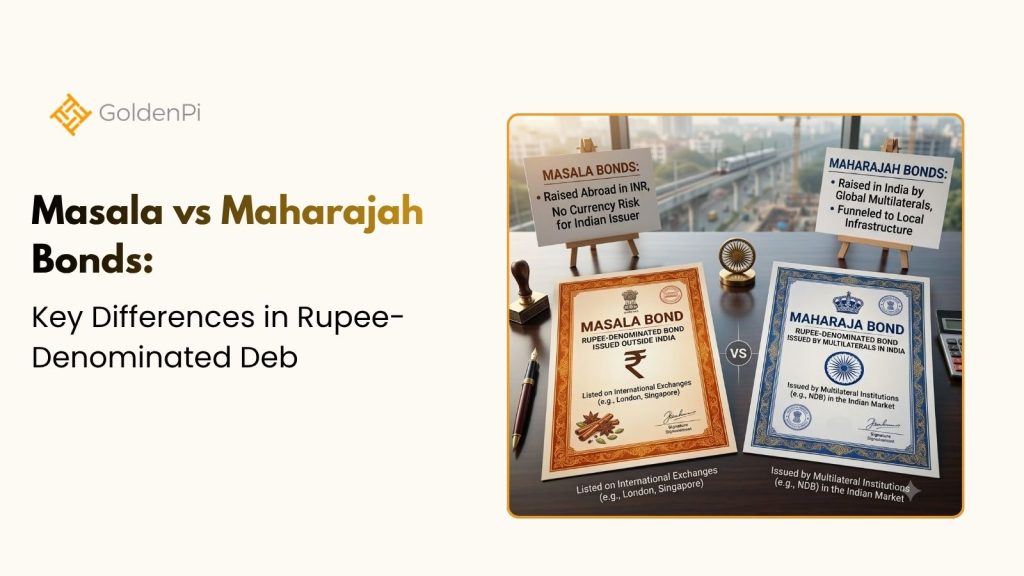
Masala bonds and Maharajah bonds sound like cousins, and in a way they are. Both are rupee-denominated debt, and both have been backed by global lenders like the International Finance Corporation (IFC). But they are sold in different places, to different investors, under different rules. The difference is back in the spotlight because on 19 October 2026 the Central Board of Direct Taxes (CBDT) notified an exemption from TDS on interest from the New Development Bank’s (NDB) Maharajah Rupee Bonds from the 2026-27 tax year. This guide explains the two instruments, how they differ, and what it means for Indian investors.
Start investing with just ₹10K & grow your wealth with fixed return opportunities.
Invest Now

What Are Masala Bonds?
Masala bonds are rupee-denominated bonds sold to investors outside India. The currency risk sits with the investor, not the issuer. A landmark came in November 2014, when IFC raised ₹1,000 crore through a 10-year bond that was the first rupee bond listed on the London Stock Exchange.
The RBI then amended its ECB policy in 2015 and 2016 to facilitate Masala issuances, opening the route to Indian issuers. Corporates took to it quickly: Indian firms raised ₹33,165 crore through Masala bonds between September 2016 and April 2017 alone. So Masala bonds have come from both multilaterals and Indian companies, always sold abroad.
What Are Maharajah Bonds?
Maharajah bonds flip the location. They are rupee bonds issued inside India’s domestic market by a foreign or multilateral issuer. The NDB’s version is issued within India and denominated in rupees. IFC’s 2014 debut was an early example. It was listed on the NSE and billed as the first international AAA issuance in the country.
Masala vs Maharajah Bonds: Key Differences
| Feature | Masala Bonds | Maharajah Bonds |
| Where issued | Overseas (e.g., London) | Indian domestic market |
| Typical issuers | Indian entities and multilaterals like IFC | Foreign or multilateral issuers (IFC, NDB) |
| Typical investors | Global institutions | Domestic institutions (e.g., insurers) and eligible foreign investors |
| Listing | Offshore exchanges such as LSE | Indian exchanges such as NSE |
| Rupee risk | Borne by the investor | None for Indian investors |
| Regulatory route | RBI’s ECB framework plus listing-country rules | Domestic securities rules, with RBI and government support |
| Tax on interest | Historically a concessional 5% withholding for foreign investors; offshore concession reportedly lapsed in mid-2023 | Normal TDS applies unless exempted; NDB’s bonds exempted by CBDT notification, but interest is still taxable |
Who Really Carries the Currency Risk?
Imagine a London fund buys a Masala bond with a 7% coupon, and the rupee falls about 3% against the dollar over the year. Its dollar return is roughly 4%. An Indian insurer holding a Maharajah bond earns the full 7% in rupees, with no exchange-rate drag. (The numbers are illustrative.) That is why overseas buyers typically want a yield that compensates for rupee risk, while Maharajah bonds suit domestic institutions that already think in rupees.
How Are They Regulated and Taxed Differently?
The rulebooks diverge more than most people expect:
- Regulation of Masala Bonds: They fall under the RBI’s ECB framework. In 2017, the RBI aligned them more closely with ECB norms and capped the interest payable. Later analysis says issuances can generally use the automatic route without prior RBI approval, up to set limits. Under the original guidelines, Indian residents were not eligible investors.
- Regulation of Maharajah Bonds: They are domestic securities. The insurance regulator IRDAI noted that NDB’s proposed onshore bonds fall within the definition of “Securities” under the Securities Contracts (Regulation) Act, 1956, and allowed insurers to treat them as approved investments, subject to conditions.
- Tax on Masala Bonds: Foreign investors historically got a concessional deal: a 5% withholding rate, plus relief on gains from rupee appreciation. One recent explainer says the withholding concession for bonds issued outside India was not extended beyond 30 June 2023, though qualifying bonds issued through an IFSC such as GIFT City can still benefit, subject to conditions.
- Tax on Maharajah Bonds: Interest is taxed under the normal rules, including TDS, unless the government specifically exempts it. For NDB’s bonds, the CBDT notified such an exemption, covering eligible resident investors and FIIs from 2026-27. The relief comes from that notification, not from the “Maharajah” label, so it shouldn’t be assumed for other issuers. Interest remains taxable for resident investors, who must still report it and pay tax at applicable rates. This is a cash-flow benefit, not a tax-free return.
- Capital treatment: The NDB has sought zero risk weight in local currency for its bonds, though confirmation that this has been granted is not yet public.
Latest Bond Updates:
- Masala vs Maharajah Bonds: Clearing the Confusion Around Rupee-Denominated Debt
- Maharajah Bonds Explained: How Multilaterals Issue Rupee Debt in India

- How to Compare Two Bonds Side by Side: A 10-Point Checklist

Where Do the Two Markets Stand in 2026?
The Masala bond market has cooled. One analysis notes almost no large new issuances on the LSE after 2020, blaming thin offshore rupee liquidity. The same analysis says the rupee fell nearly 30% between 2013 and 2022, which weighed on foreign investors’ returns.
Maharajah bonds, meanwhile, are in an expansion phase. The NDB has proposed ₹25,000 crore over five years. That is larger in rupee terms than IFC’s earlier programme, pegged at about ₹15,000 crore, though the rupee has weakened since 2014, so the gap in dollar terms is far smaller. In August, a senior NDB official said the bank was advancing its first onshore Maharajah bond with support from the Government of India and RBI. Investors should watch for the first tranche, since a programme ceiling is not an issuance.
Choosing Between Masala and Maharaja Bonds
If you are an Indian institution or fixed-income investor, Maharajah bonds are the more natural fit today. They sit in your own market and currency, with domestic tax and regulatory treatment. Masala bonds matter mostly to overseas investors and to issuers who want global money without taking currency risk themselves. Both are rupee debt, but they serve different buyers.
Masala vs Maharajah Bonds Frequently Asked Questions
Masala bonds are rupee-denominated bonds issued outside India. They allow Indian companies and eligible institutions to raise funds from overseas investors without making the issuer’s repayment obligation directly dependent on the rupee’s exchange rate against a foreign currency.
Maharajah bonds are rupee-denominated bonds issued within India’s domestic debt market by the New Development Bank (NDB). They allow the multilateral development bank to raise rupee funds for financing projects.
The main difference is where the bonds are issued. Masala bonds are issued in overseas markets, while Maharajah bonds are issued in India. Both are denominated in Indian rupees, but they differ in issuer eligibility, regulatory framework and investor access.
Yes. Their principal and interest obligations are denominated in rupees, even though the bonds are issued outside India. This means the Indian issuer’s repayment obligation is rupee-based, while overseas investors may still face currency risk when converting their returns into their home currency.
Yes. Maharajah bonds are denominated and issued in Indian rupees in the domestic market. This lets NDB raise funds in the currency used for eligible rupee financing and avoid directly tying its rupee borrowing obligations to a foreign currency.
The overseas investor generally bears the currency risk when converting rupee interest and principal repayments into their own currency. If the rupee depreciates against that currency, the investor’s converted return may fall. The Indian issuer’s contractual payment obligation remains denominated in rupees.
Investors whose spending or reporting currency is not the rupee may face exchange-rate risk when converting returns. For NDB, raising rupees can help match funding with rupee-denominated lending, reducing the currency mismatch that can arise when borrowing in one currency and lending in another.
Disclaimer
Fixed returns do not constitute guaranteed or assured returns. Investments in corporate debt securities and municipal debt securities/securitized debt instruments are subject to credit risks, market risks, and default risks, including delay and/or default in payment. Read all the offer-related documents carefully. This blog/article should not be construed as financial advice or as an offer or recommendation to buy or sell any security or any products/services of/on GoldenPi or any product/services of its third-party client(s). For a detailed calculation of YTM, visit our website. T&C’s Apply.


