
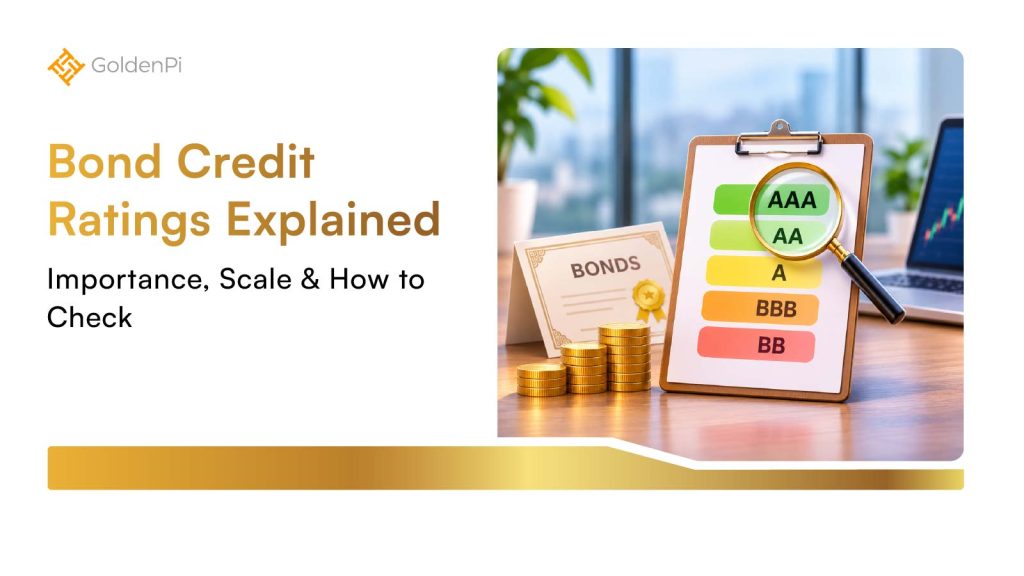
Ever noticed a code like AAA or BBB- next to a bond and wondered what it’s telling you? That’s a credit rating, and bond credit ratings in India are one of the simplest tools you have for judging a bond. In short, they’re letter grades, from AAA down to D, that show how likely a company or government is to pay back the money it borrows. Think of a rating as the borrower’s report card.
For you as an investor, it works like a quick safety check. A glance tells you how risky a bond is, so you can compare options without digging through pages of financial statements. It also helps you see whether the returns on offer are worth the risk. From 21 November 2026, SEBI, India’s market regulator, also requires online bond platforms to show a colour-coded Credit Risk-o-Meter on their web and mobile platforms.
In this guide, we’ll look at who hands out these ratings, what each grade means, how ratings connect to the returns you earn, and what to check before you invest.
Key Takeaways
- The scale: Ratings run from AAA (lowest credit risk) to D (default), and BBB- is the last investment-grade step.
- Why they matter: A rating gives you a quick, independent read on an issuer’s credit risk, but a higher yield usually signals higher risk.
- Where to check: Look at the Credit Risk-o-Meter on the platform, then confirm the rating on the agency’s own website, matched to the exact bond.
- The fine print: Read the plus or minus, the outlook, any rating watch, and tags like (CE) and INC. If a bond has several ratings, the Risk-o-Meter shows the lowest.
- The limits: A rating isn’t a guarantee. It doesn’t cover market risk or liquidity risk, and it can change.
- Before you invest: Read the rating rationale and the offer document, which sets out the bond’s terms.
Start investing with just ₹30K & grow your wealth with fixed return opportunities.
Invest Now

What Is a Bond Credit Rating?
A bond is a loan you give to a company or government, called the issuer. It promises to pay you regular interest (the coupon) and return your original money (the principal) on a fixed maturity date. The risk is default, which simply means the issuer fails to pay on time. This risk is called credit risk.
A credit rating is an independent opinion on how likely that is. Think of it as a school report card for the borrower: the higher the grade, the lower the credit risk. It’s an opinion, not a promise.
Importance of Credit Ratings for Investors
A bond pays you back from the issuer’s future earnings, and you can’t see those from the outside. A credit rating gives you a trained opinion on that question, from an agency that has studied the issuer’s finances. It saves you from decoding balance sheets yourself.
Ratings also help you compare. Two bonds can offer similar returns while carrying very different risk, and the rating shows you the difference at a glance. They also keep the return in perspective: a high coupon (the interest rate) next to a low rating tells you the issuer is paying extra for a reason. That’s why SEBI’s Credit Risk-o-Meter exists. It turns the alphanumeric symbols into a colour-coded gauge that retail investors can read easily.
Who Gives Bond Credit Ratings in India?
Ratings come from credit rating agencies (CRAs), firms that study an issuer’s finances and publish a grade. SEBI registers and regulates them. As of March 2026, eight CRAs were registered with SEBI, including CRISIL, ICRA, CARE, India Ratings, Acuité and Infomerics.
The issuer usually pays for its own rating, which is why SEBI’s rules on disclosure and conduct matter. For the Risk-o-Meter, online bond platforms must use only ratings from SEBI-registered agencies.
Latest Bonds Updates:
- Embassy Group Bonds: REIT, Developments, and Tapir Constructions

- Bond Credit Ratings Explained: Importance, Scale & How to Check
- “Senior” and “Secured” Bond Explained: How Collateral and Priority Protect Corporate Bondholders in India

Bond Credit Rating Scale: AAA to D
Bonds maturing in more than a year use the long-term scale (AAA to D). Instruments maturing in up to a year, such as commercial paper (short-term IOUs issued by companies), use the short-term scale (A1+ to D).
SEBI’s Credit Risk-o-Meter, a speedometer-style gauge, maps ratings from AAA to D into six risk levels:
| Risk-o-Meter level | Long-term rating | Short-term rating | Meter colour | Grade |
| Lowest credit risk | AAA | A1+ | Irish Green | Investment grade |
| Very low credit risk | AA+, AA, AA- | A1 | Chartreuse | Investment grade |
| Low credit risk | A+, A, A- | A2 | Neon Yellow | Investment grade |
| Moderate credit risk | BBB+, BBB, BBB- | A3 | Caramel | Investment grade |
| Moderate risk of default | BB+, BB, BB- | A4+ | Dark Orange | Non-investment grade |
| High to very high risk of default | B+ to B-, C+ to C-, D | A4, D | Red | Non-investment grade |
Source: SEBI circular dated 7 October 2026.
D means the issuer is in default or expected to be.
The BBB- line matters. BBB- and above is investment grade, meaning the issuer is judged reasonably able to repay. BB+ and below are non-investment grade, often called “junk” or “high-yield.” Many institutions, such as mutual funds and insurers, have rules that limit how much they can hold below that line.
Example: Say XYZ Finance Ltd (a made-up company) is rated BBB-. If it slips one step to BB+, some institutions may have to sell their holdings around the same time, which can push the bond’s price down sharply.
What Do “+”, “-“, Outlook and Rating Watch Mean?
Plus and minus signs: These show a step up or down within a grade, so AA+ is one step above AA, and AA- is one step below. AAA has no “+” because nothing ranks higher. Note that SEBI’s Risk-o-Meter groups all steps of a grade together, so AA+, AA and AA- show the same colour. The sign is worth reading in the rating itself.
Outlook: This is the agency’s view of where a rating may head. It looks at the direction a rating may move over the medium term, one to two years, and comes as Positive, Stable or Negative. Think of it as a weather forecast. A negative outlook isn’t a downgrade, and a positive or negative outlook doesn’t necessarily lead to a rating change.
Rating Watch: This is a sharper, shorter-term signal, more like a storm alert. An agency places a rating on watch when a specific event has happened or is expected soon and its impact on credit quality needs assessing. It can carry positive, negative or developing (could go either way) implications. A rating on watch doesn’t carry an outlook. Some agencies call this “Credit Watch,” so don’t get confused by the name.
How Do Credit Ratings Affect Bond Returns?
Lenders want to be paid for taking risks. So a lower-rated issuer usually offers a higher yield, the annual return you earn on a bond given its price. The extra yield over very safe benchmarks, such as government bonds, is called the credit spread. That’s why a BBB bond may advertise a higher yield than an AAA bond.
A higher yield isn’t a bonus. It’s compensation for a higher chance of things going wrong.
How to Check a Bond’s Credit Rating
Start with the bond’s page on the platform. The Credit Risk-o-Meter must appear on the bond listing and details pages, before the investment action buttons, and below it you’ll see the rating agency’s name and the actual rating.
Next, verify it at the source. Every agency publishes its ratings on its own website, usually with a rating rationale (the note explaining the grade). Search by the issuer’s name and look at the latest report. Issuers also announce rating changes to the stock exchanges, and the bond’s offer document states the rating at the time of issue.
Two habits help here. Ratings are given to specific instruments, not just to a company, so match the rating to the exact bond you’re looking at. And check the date, because a rating from a year ago may have changed.
What to Check Beyond a Bond’s Credit Rating
A rating is a starting point. Here’s what to check:
- Agency, date and outlook. Note who rated the bond and when. The outlook (positive, stable or negative) hints at where the rating may head next.
- The lowest-rating rule. If a bond has ratings from several agencies, the Risk-o-Meter reflects the lowest rating. Example: if one agency says AA+ and another says AA, the meter shows AA.
- Secured or unsecured. A secured bond is backed by assets the lender can claim if the issuer fails. For unsecured bonds, the word “unsecured” must appear in bold red text.
- The (CE) tag. It stands for Credit Enhancement: the rating relies on outside support, such as a parent company’s guarantee, rather than the issuer alone. You may also see (SO), for bonds backed by a pool of loans, or “Provisional,” meaning the rating isn’t final yet.
- The INC tag. It stands for “Issuer Not Cooperating”: the company has stopped sharing information with its rating agency. If all of an issuer’s ratings stay non-cooperative for more than six months, the agency must downgrade the rating to non-investment grade. The meter then shows INC.
- The rationale report. Agencies publish a note explaining each rating. A few minutes with it tells you more than the letters alone.
What a Credit Rating Doesn’t Tell You
A rating is not a guarantee. Even a AAA corporate bond isn’t backed by the government, and “lowest credit risk” doesn’t mean zero risk. A rating also measures the chance of default, not how much you’d get back if the issuer fails, which is why secured or unsecured status matters.
It doesn’t cover market risk either, meaning the risk that a bond’s price moves with interest rates.
Example: a 10-year AAA bond has very low default risk, but if the Reserve Bank of India raises interest rates, its market price can still fall. Nor does it cover liquidity risk, which is the difficulty of selling quickly at a fair price.
Finally, ratings change. Platforms must update the Risk-o-Meter within 24 hours of being notified of a rating change.
Bond Credit Ratings: FAQs
A credit rating is an independent agency’s opinion of the likelihood that an issuer will repay a bond’s principal and interest on time. It helps investors assess credit risk but is not a recommendation to buy or sell the bond.
Ratings from AAA to BBB-, including their applicable plus and minus modifiers, are classified as investment grade. BB+ and below are considered speculative grade, indicating materially higher credit risk.
They indicate the relative standing of a rating within its category. For example, AA+ is stronger than AA, while AA- is weaker. However, AA- is still a higher rating than A+.
Yes. Rating agencies assess individual debt instruments, and their ratings may differ depending on security, seniority, guarantees, repayment structure and other factors. A company’s secured NCD may therefore have a different rating from its unsecured borrowing.
SEBI-registered credit rating agencies (CRAs), such as CRISIL Ratings, ICRA, CARE Ratings, India Ratings, Acuité Ratings and Infomerics, assess and rate debt instruments and issuers.
Disclaimer
Fixed returns do not constitute guaranteed or assured returns. Investments in corporate debt securities and municipal debt securities/securitized debt instruments are subject to credit risks, market risks, and default risks, including delay and/or default in payment. Read all the offer-related documents carefully. This blog/article should not be construed as financial advice or as an offer or recommendation to buy or sell any security or any products/services of/on GoldenPi or any product/services of its third-party client(s). For a detailed calculation of YTM, visit our website. T&C’s Apply.


