
A ₹50 lakh fixed deposit can generate a substantial stream of predictable income, but the exact monthly amount depends on the interest rate, tenure, customer category, and payout structure. At a 6.5% annual rate, for example, ₹50 lakh produces a simple monthly equivalent of about ₹27,083 before tax. At 8%, the figure rises to ₹33,333. But those aren’t necessarily the amounts that will actually be credited every month. Banks can calculate monthly FD payouts at a discounted rate, and the applicable interest rate depends on the tenure chosen.
For an investor deploying ₹50 lakh, there is another issue that doesn’t arise to the same extent with a smaller FD: concentration risk. DICGC insurance covers eligible bank deposits only up to ₹5 lakh per depositor per bank, including principal and interest. So the question isn’t simply where ₹50 lakh earns the highest headline rate. It is how the money fits into the investor’s broader fixed-income strategy.
Start investing with just ₹10K & grow your wealth with fixed return opportunities.
Invest Now

₹50 Lakh FD Monthly Interest Across Banks in 2026
The table below uses selected current rates for deposits below ₹3 crore. These are illustrative rate points rather than a ranking, since the banks offer the quoted rates at different tenures.
| Bank | Illustrative tenure | Rate | Simple monthly equivalent on ₹50 lakh* |
| SBI | 2 years to <3 years | 6.40% | ₹26,667 |
| HDFC Bank | 18 months to <3 years | 6.45% | ₹26,875 |
| ICICI Bank | 3 years 1 day to 5 years | 6.50% | ₹27,083 |
| Kotak Mahindra Bank | 2 years to <3 years | 6.80% | ₹28,333 |
| YES Bank | 18 months 1 day to <24 months | 7.25% | ₹30,208 |
| Suryoday SFB | 30 months | 8.10% | ₹33,750 |
*Simple calculation: ₹5,000,000 × annual interest rate ÷ 12. Actual monthly payout may differ because banks can discount interest for monthly payments. Rates are subject to change.
The underlying rates should be checked against the banks’ current schedules before publication. SBI currently lists 6.40% [1] for two years to less than three years, while HDFC Bank lists 6.45% [2] for 18 months to less than three years. ICICI Bank’s maximum general-customer rate is currently 6.50% [3] on selected longer tenures. Kotak’s selected rate is 6.80% [4], while YES Bank’s rate for 18 months and 1 day to less than 24 months is 7.25% [5].
Suryoday SFB’s 8.10% [6] rate applies to its 30-month tenure for regular customers. Its rates can be higher than those offered by large private and public-sector banks, but the comparison should account for the different institutions and tenures.
Latest Fixed Deposit Updates:
- Cumulative vs Non-Cumulative FD: Which Payout Option Earns More?
- Sweep-In FD Explained: How Auto-Sweep Accounts Work in India

- SBI FD Interest Rates in Oct 2026: Latest Rates, Features, and Things Investors Should Know
How Much Monthly Interest Does ₹50 Lakh Earn at Different FD Rates?
For a quick estimate: Monthly interest ≈ ₹5,000,000 × interest rate ÷ 12
| FD rate | Annual interest on ₹50 lakh | Simple monthly equivalent |
| 5.00% | ₹250,000 | ₹20,833 |
| 6.00% | ₹300,000 | ₹25,000 |
| 6.50% | ₹325,000 | ₹27,083 |
| 7.00% | ₹350,000 | ₹29,167 |
| 7.50% | ₹375,000 | ₹31,250 |
| 8.00% | ₹400,000 | ₹33,333 |
| 8.50% | ₹425,000 | ₹35,417 |
This is a useful back-of-the-envelope calculation, but it shouldn’t be confused with the actual monthly payout. ICICI Bank, for example, states that monthly interest is calculated by discounting the quarterly interest rate, while other banks have their own payout methodology.
What Is the Monthly Interest on ₹50 Lakh FD After Tax?
The headline interest isn’t the same as spendable income. Suppose ₹50 lakh earns 7% a year. The simple annual interest is ₹3.5 lakh, or approximately ₹29,167 a month before tax.
The actual post-tax income depends on the investor’s overall taxable income and applicable tax provisions. FD interest is generally taxable, while TDS is simply a mechanism for collecting tax at source when the applicable conditions are met.
For an investor in a higher marginal tax bracket, the difference can be substantial. This is why a 7.25% FD isn’t automatically more attractive than a lower-rate instrument with a different tax treatment.
₹50 Lakh FD for Senior Citizens
Senior citizens generally receive an additional interest rate on eligible bank FDs, although the premium varies between banks and tenures. For example, HDFC Bank currently offers higher rates to senior citizens on eligible deposits, while ICICI Bank’s senior-citizen rate reaches 7.10% on selected tenures.
The key point is that the senior-citizen premium should be checked for the specific bank and tenure rather than assumed to be a universal additional 0.50%.
Monthly Payout FD vs Cumulative FD
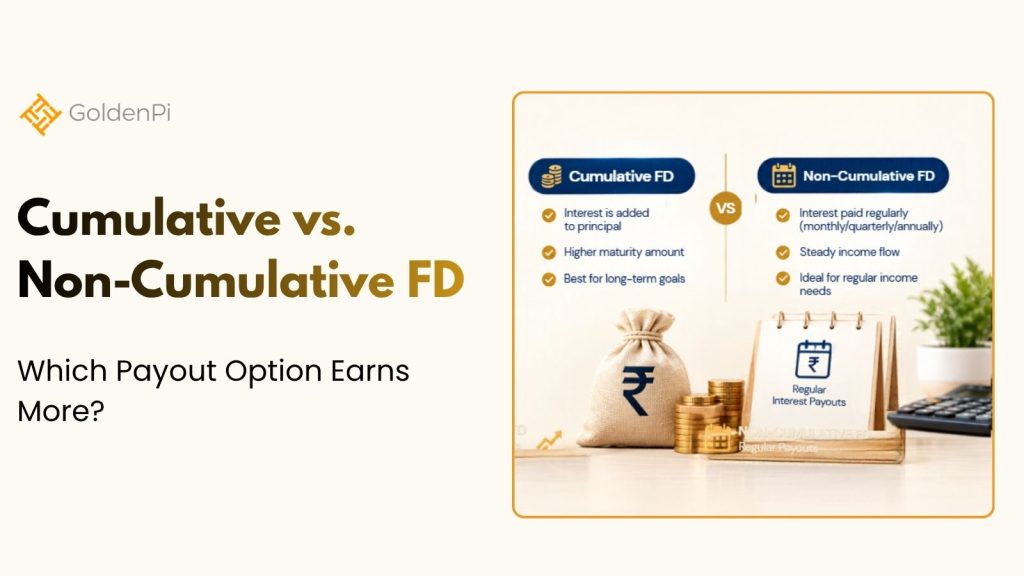
A monthly-payout FD sends interest to your bank account regularly. This can suit someone using the ₹50 lakh corpus to fund expenses or supplement other income. A cumulative FD, on the other hand, generally reinvests the interest until maturity. That means there is no monthly cash flow, but the accumulated interest can compound.
The choice comes down to what the money is supposed to do:
- Need regular income: compare monthly or quarterly payout options.
- Don’t need the income immediately: compare cumulative maturity values.
- Need liquidity: examine premature-withdrawal rules before locking in the entire corpus.
There is no inherent “better” structure; the appropriate choice depends on the purpose of the money.
Is ₹50 Lakh in One Bank FD Safe?
This is where a ₹50 lakh FD needs more thought than a smaller deposit. DICGC insurance covers eligible deposits up to ₹5 lakh per depositor per bank, including principal and interest. Deposits across branches of the same bank are aggregated for the insurance limit.
That doesn’t mean a ₹50 lakh FD is unsafe. It means that ₹45 lakh of the principal is outside the statutory ₹5 lakh deposit-insurance limit, assuming the depositor has no other deposits at that bank that consume part of the insured amount. An investor with a large bank-deposit allocation may therefore consider spreading deposits across institutions after assessing each bank’s rates, terms, and financial position.
₹50 Lakh FD vs. Bonds: What Should Investors Compare?
For investors who already have a sizeable fixed-income allocation, bank FDs aren’t the only option. Bonds can offer a defined coupon and maturity structure, but they introduce risks that don’t apply in exactly the same way to bank deposits, including credit risk, liquidity risk, and market-price risk if sold before maturity.
A bond that offers a higher yield should therefore not be treated as a direct substitute for an FD without examining the issuer and instrument. For an investor holding ₹50 lakh specifically for predictable cash flow, the comparison should focus on yield, credit quality, maturity, liquidity, taxation, and whether the investor intends to hold the instrument to maturity.
₹50 Lakh FD vs Debt Mutual Funds
Debt mutual funds work differently from FDs. They don’t offer a predetermined interest rate or guaranteed maturity value, and their NAV can fluctuate as interest rates and bond prices change. Their advantage is flexibility and diversification across debt securities. The trade-off is that the investor takes market and portfolio risks rather than locking in a bank FD rate.
For money that must be available at a known value on a known date, an FD may have a different role from a debt fund. For a longer-term fixed-income allocation where some NAV movement is acceptable, the comparison becomes more relevant.
50 Lakh FD Interest Rate Frequently Asked Questions
Generally, yes, eligible senior citizens receive higher rates at many banks. The additional rate depends on the bank and tenure.
No. DICGC insurance covers eligible deposits up to ₹5 lakh per depositor per bank, including principal and interest.
Beyond interest-rate and liquidity considerations, the key issue is concentration: only ₹5 lakh per depositor per bank is covered by DICGC insurance.
Yes. FD interest is generally taxable at the applicable income-tax rate. The amount credited to your account is therefore not necessarily the amount you ultimately keep after tax.
A monthly-payout FD suits investors who need regular income. A cumulative FD reinvests interest and can generate a larger maturity amount through compounding. The better option depends on whether your priority is cash flow or corpus growth.
Sources
- SBI — Retail Domestic Term Deposit Rates
- HDFC Bank — FD Interest Rates
- ICICI Bank — FD Interest Rates
- Kotak Mahindra Bank — FD Interest Rates
- YES Bank — FD Interest Rates
- Suryoday Small Finance Bank — Fixed Deposits
Disclaimer
Fixed returns do not constitute guaranteed or assured returns. Investments in corporate debt securities and municipal debt securities/securitized debt instruments are subject to credit risks, market risks, and default risks, including delay and/or default in payment. Read all the offer-related documents carefully. This blog/article should not be construed as financial advice or as an offer or recommendation to buy or sell any security or any products/services of/on GoldenPi or any product/services of its third-party client(s). For a detailed calculation of YTM, visit our website. T&C’s Apply.


