Oil defined the 20th century. Semiconductors may define the 21st. And India has just entered the race—later than most, but perhaps just in time.
When PM Modi visited the Netherlands and signed a cooperation agreement with ASML—the world’s most important chip-making company—most headlines called it a diplomatic win. That is an understatement. To understand why, we need to start from the beginning.
Start investing with just ₹10K & grow your wealth with fixed return opportunities.
Invest Now

What exactly is a semiconductor, and why should you care?
Think of a chip as the brain inside every device you use. Your UPI transaction, the Instagram reel you scrolled, the car your neighbor drives—all run on chips. They are invisible, everywhere, and absolutely indispensable. Yet India imports nearly ₹2 lakh crore ($24–25 billion) worth of chips every year and manufactures almost none domestically.

Why did AI change everything?
Until recently, chips powered electronics. Today, they power intelligence itself. Every AI model—ChatGPT, Gemini, or India’s emerging systems—runs on thousands of specialized chips. Training a single large AI model costs $100M+ in computing alone. This is why Nvidia crossed a $3 trillion market cap and why the US, China, and Europe are spending hundreds of billions on domestic chip capacity. Chips are no longer just components—they are geopolitical currency.
Chips are to AI what fuel is to cars. Whoever controls chip supply may control the future economy.
Why does ASML matter for India?
ASML is the only company in the world making EUV lithography machines—the devices that print circuits onto silicon. One machine costs $200-350 million. Without them, there are no advanced chips. This is why China, despite spending $150B+ on its chip ambitions, is still struggling—the US has blocked ASML exports to China. India’s ASML partnership signals to the world that India is a serious player in this supply chain.
India’s opportunity
GDP growth, exports and import substitution
India’s India Semiconductor Mission (ISM) offers up to 50% fiscal support on project costs, backed by a ₹76,000 crore PLI scheme. Tata Electronics is building India’s first commercial fab in Dholera ($11B), Gujarat. Micron Technology has invested $825M in a packaging facility in Gujarat. CG Power-Renesas ATMP unit adds another ₹7,600 crore. If even 30% of India’s chip imports are substituted domestically, the trade balance improvement runs into billions of dollars annually.
Jobs, ecosystem and infrastructure
As per the data from the U.S. Semiconductor Industry Association (SIA), it shows that for every direct worker in the semiconductor sector, about 5.7 more jobs are created across the wider economy.
Chip design engineers in India earn ₹15-40 lakh per annum—far above conventional manufacturing wages. India already has ~20% of the world’s chip design engineers, a head start no country can buy overnight.
The Dholera fab alone is accelerating road, power, and water infrastructure for the entire region.
Must Read Articles:
- The Fed Ripple Effect: How a Rate Hike in Washington Hits Your Wallet in India

- India’s Chip Moment: Why the Semiconductor Race Could Redefine India’s Economy
- China’s Digital Yuan: How the e-CNY Could Disrupt SWIFT, Devalue the Dollar, and Reshape Global Finance

Strategic and Geopolitical
Defence, supply chain trust & global relevance
Modern defense—fighter jets, drones, missiles, and radar—runs entirely on chips. Domestic capability directly reduces India’s defense electronics import bill.
Globally, companies want a “China+1” supply chain. India’s democratic institutions and English-speaking technical workforce make it the natural candidate.
The India-US initiative on Critical and Emerging Technologies (iCET) specifically targets semiconductor cooperation – a signal that the US sees India as a long-term strategic partner in chip supply chain resilience.
Data centres, AI infrastructure & deep-tech startups
Microsoft ($3B), Google ($2B), and Amazon (₹1.25 lakh crore over 15 years) have committed data center investments in India—each facility consuming enormous quantities of chips. As manufacturing matures, India could develop globally competitive chip design companies like Tata Elxsi and L&T Semiconductor Technologies—India’s answer to Qualcomm or ARM.
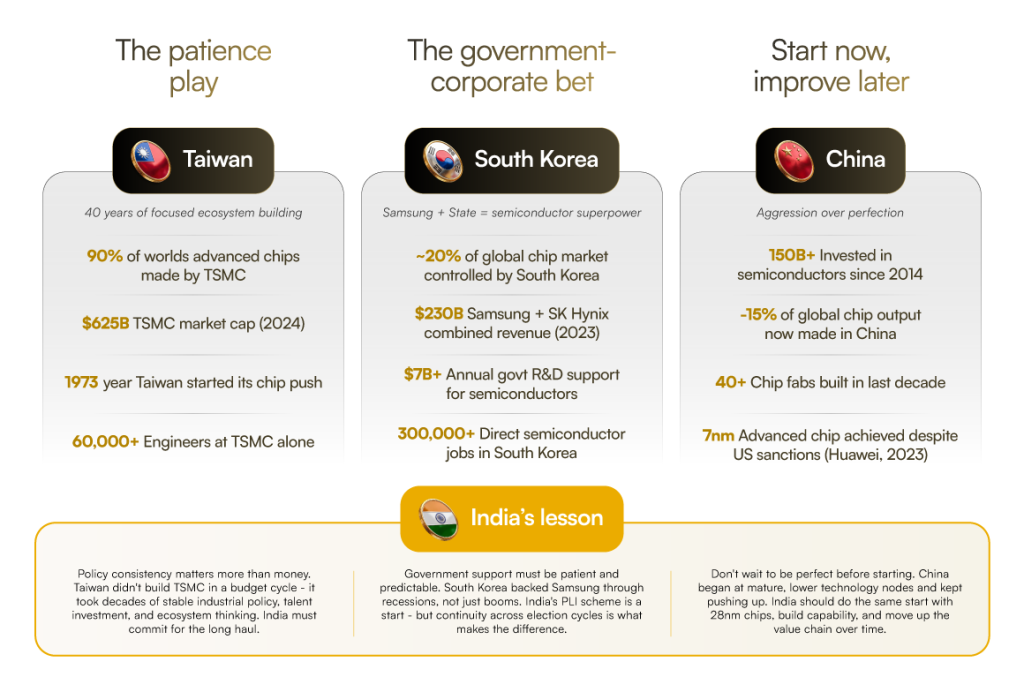
What can India learn from others?
Challenges India must not ignore
- Enormous capital needed: A single advanced fab costs $15-20B. Government subsidies help, but private capital at this scale is hard to sustain.
- 30-year technology gap: India’s initial fabs will make mature-node chips (28nm+), not the 3nm chips in your iPhone. That’s fine—but the gap is real.
- Power and water constraints: A single fab can consume as much electricity as a small city and millions of liters of ultra-pure water daily.
- Long gestation period: Fabs take 4-6 years to build. Results won’t appear in one budget cycle—political patience is essential.
Who benefits in India?
Sectors across the board gain: EVs, defense, data centers, and telecom. Notable companies operating in this space are as follows:
- Tata Electronics
- Dixon Technologies
- Keynes Technology
- CG Power
- Tata Elxsi
- Bharat Electronics
- L&T Semiconductor
- Micron India
- Alvon Technologies
- SFO Technologies
Conclusion
India missed the global manufacturing revolution led by China in the 1990s. The semiconductor and AI revolution may be India’s second historic opportunity—and this time, India is at the starting line.
The countries that control chip manufacturing will shape AI, defense, and economic growth for decades. Backed by ₹76,000 crore in PLI support, ASML access, and Tata’s Dholera fab, India’s semiconductor push is not just industrial policy—it is a long-term national strategy. Executed with patience, it could add 1.5-2 percentage points to GDP growth by 2035 and create millions of high-income jobs.
The chip is small. The opportunity is enormous.
Data Source: India Semiconductor Mission (MeitY), Union Budget 2023–24 PLI allocations, Economic Survey 2023–24, WSTS, SEMI industry reports
Disclaimer
Fixed returns do not constitute guaranteed or assured returns. Investments in corporate debt securities and municipal debt securities/securitized debt instruments are subject to credit risks, market risks, and default risks, including delay and/or default in payment. Read all the offer-related documents carefully. This blog/article should not be construed as financial advice or as an offer or recommendation to buy or sell any security or any products/services of/on GoldenPi or any product/services of its third-party client(s). For a detailed calculation of YTM, visit our website. T&C’s Apply.