A ₹10 lakh fixed deposit can generate a useful monthly income, but how much you actually receive depends on where the FD is booked, the tenure, the applicable interest rate, and whether you choose monthly or cumulative interest.
At current 2026 rates, a ₹10 lakh FD at around 6.25% works out to roughly ₹5,200 a month on a simple annual-rate basis, while a 7% rate works out to about ₹5,800. Some small finance banks are offering rates above 8% on selected tenures, taking the simple monthly equivalent above ₹6,600. However, the actual monthly payout can be slightly different because banks such as HDFC Bank and ICICI Bank calculate monthly payouts at a discounted value.
So, if you’re considering a ₹10 lakh FD for regular income, the right question isn’t simply “How much interest will ₹10 lakh earn?” It is “How much monthly cash flow will this particular FD actually generate?”
Start investing with just ₹10K & grow your wealth with fixed return opportunities.
Invest Now

₹10 Lakh FD Monthly Interest Across Major Banks in 2026
Rates vary by tenure, so there isn’t one monthly-income figure for each bank. The following illustration uses selected current rates for deposits below ₹3 crore, rather than attempting to rank the banks.
| Bank | Illustrative tenure/rate | Approximate monthly equivalent on ₹10 lakh* |
| SBI | 2 years to <3 years: 6.40% | ₹5,333 |
| HDFC Bank | 18 months to 3 years: 6.45% | ₹5,375 |
| ICICI Bank | 3 years 1 day to 10 years: 6.50% | ₹5,417 |
| Kotak Mahindra Bank | 2 years to <3 years: 6.80% | ₹5,667 |
| YES Bank | 18 months 1 day to <24 months: 7.25% | ₹6,042 |
| Suryoday SFB | 30 months: 8.10% (regular citizens; 8.25% for senior citizens) | ₹6,750 |
These are simple monthly equivalents calculated as ₹10 lakh × annual interest rate ÷ 12, before taxes. Actual monthly-payout amounts can differ because banks may apply a discounted monthly payout methodology. Rates are also tenure-specific and can change. HDFC’s current retail rates, effective 19 August 2026, show 6.45% [1] for several 18–35 month buckets, while ICICI’s rates, effective 1 August 2026, include 6.45% [2] for 2 years 1 day to 3 years.
SBI’s published retail deposit schedule currently shows 6.40% [3] for two years to less than three years, while YES Bank’s published rate for 18 months 1 day to less than 24 months is 7.25% [4]. Suryoday’s rates were revised from 15 August 2026 [5], with regular customers offered up to 8.25% on selected tenures.
The table illustrates an important point: a 1 percentage-point difference in interest rate changes the simple monthly equivalent on ₹10 lakh by about ₹833.
Latest Bond Updates:
- G-Sec STRIPS Explained: Zero-Coupon Sovereign Paper for Retail

- Cumulative vs Non-Cumulative FD: Which Payout Option Earns More?
- Sweep-In FD Explained: How Auto-Sweep Accounts Work in India

How Much Monthly Interest Does ₹10 Lakh Earn at Different FD Rates?
A quick way to estimate the income is the following:
Monthly interest ≈ ₹1,000,000 × interest rate ÷ 12
| FD rate | Approx. monthly interest | Approx. annual interest |
| 5.00% | ₹4,167 | ₹50,000 |
| 6.00% | ₹5,000 | ₹60,000 |
| 6.50% | ₹5,417 | ₹65,000 |
| 7.00% | ₹5,833 | ₹70,000 |
| 7.50% | ₹6,250 | ₹75,000 |
| 8.00% | ₹6,667 | ₹80,000 |
| 8.50% | ₹7,083 | ₹85,000 |
These figures are useful for a quick estimate, but they should not be treated as the exact bank credit. For example, ICICI Bank says its monthly-payout FD interest is calculated by discounting the quarterly interest accrued, while HDFC Bank similarly states that monthly interest for deposits above six months is paid at a discounted rate.
₹10 Lakh FD Monthly Interest for Senior Citizens
Senior citizens generally receive an additional interest rate on eligible bank FDs, although the premium and applicable tenures vary by bank.
For example, HDFC Bank’s current rates for deposits below ₹3 crore provide an additional 0.50 percentage point on many tenures, and even 0.60 for some, while ICICI Bank currently offers senior-citizen rates of up to 7.10% on selected tenures.
At a simple 7.50% annual rate, ₹10 lakh translates to approximately ₹6,250 a month before tax. At 8%, it becomes approximately ₹6,667. The actual amount credited can differ depending on the bank’s monthly-payout calculation.
Monthly Payout FD vs Cumulative FD: Which Gives More?
This is where the headline monthly-income calculation can become misleading.
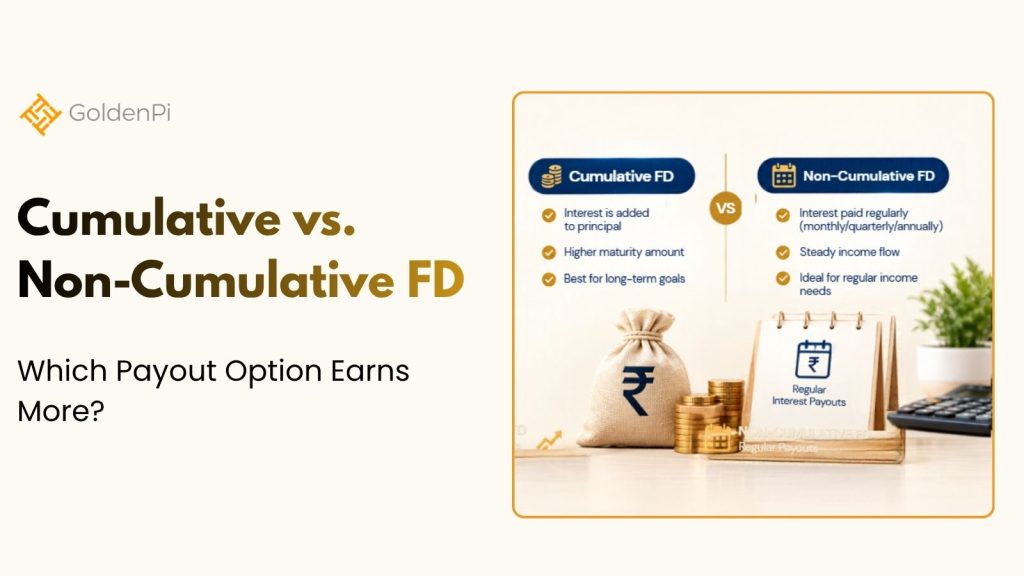
With a monthly-payout FD, interest is paid into your linked bank account rather than being reinvested. This creates regular cash flow, but you give up the benefit of compounding that comes from leaving interest invested.
With a cumulative FD, interest is generally compounded and paid at maturity. You don’t receive monthly income, but the interest itself earns interest over the tenure. So the choice is essentially between current cash flow and reinvestment.
For someone using the ₹10 lakh FD as an income-generating asset, monthly payout may be relevant. Someone who doesn’t need the income immediately may instead compare the maturity value of a cumulative FD.
How Much Tax Will You Pay on ₹10 Lakh FD Interest?
FD interest is taxable according to the applicable income-tax rules and the investor’s tax position. Therefore, the amount credited by the bank is not necessarily the amount that ultimately remains with you after tax.
For example, ₹70,000 of annual FD interest does not mean ₹70,000 of post-tax income for an investor whose marginal tax rate is higher than zero.
TDS is also separate from the final tax liability. The bank may deduct TDS when the applicable statutory conditions and thresholds are met, but the investor’s ultimate tax liability depends on their overall taxable income and applicable provisions.
For income planning, therefore, compare post-tax income rather than simply the FD’s advertised rate.
Is ₹10 Lakh FD Interest Enough for Monthly Income?
At the above-illustrated large-bank rates, ₹10 lakh generally produces a monthly equivalent in the broad ₹5,000–₹6,000 range, before tax. Higher-rate banks can take that figure higher, while shorter-tenure deposits may pay less. That means an FD corpus of ₹10 lakh is unlikely to generate a very large monthly income on its own. To receive ₹25,000 a month at a 7% annual rate, for instance, the simple calculation requires roughly ₹42.9 lakh of principal.
This is why investors looking for regular fixed-income cash flow often need to think about the size of the corpus, withdrawal rate, and inflation, rather than focusing only on the FD interest rate.
What About DICGC Insurance on a ₹10 Lakh FD?
DICGC deposit insurance covers eligible deposits up to ₹5 lakh per depositor per bank, including principal and interest. Therefore, a ₹10 lakh FD is larger than the DICGC insurance limit. This doesn’t mean the remaining amount is automatically at risk; it means the statutory deposit-insurance cover does not extend beyond ₹5 lakh per depositor per bank.
For larger cash allocations, investors may therefore consider how their deposits are distributed across banks, alongside the financial position and terms of each institution.
FD interest taxable: Frequently Asked Questions
Yes. FD interest is generally taxable according to the applicable income-tax rules and the investor’s tax slab. The monthly payout should therefore not be treated as the investor’s final post-tax income.
It depends on your objective. A monthly-payout FD can provide regular cash flow, while a cumulative FD reinvests the interest and can produce a larger maturity amount through compounding.
Not necessarily. Compare the rate, tenure, payout frequency, premature withdrawal rules, and tax impact. A slightly higher rate may come with a longer lock-in or other conditions.
Investors prioritizing deposit diversification may consider splitting the money across banks, particularly when the deposit amount exceeds the DICGC insurance limit. However, the decision should also consider rates, convenience, bank quality, and liquidity requirements.
Compare the interest rate, monthly payout, cumulative maturity value, tenure, senior-citizen benefit, premature-closure penalty, tax impact, and DICGC coverage. Most importantly, compare the amount you actually receive after tax rather than the advertised rate alone.
Sources
- HDFC Bank — Current FD Interest Rates
- ICICI Bank — Current FD Interest Rates
- SBI — Retail Domestic Term Deposit Rates
- YES Bank — Fixed Deposit Interest Rates
- The Economic Times — Suryoday SFB FD rate update