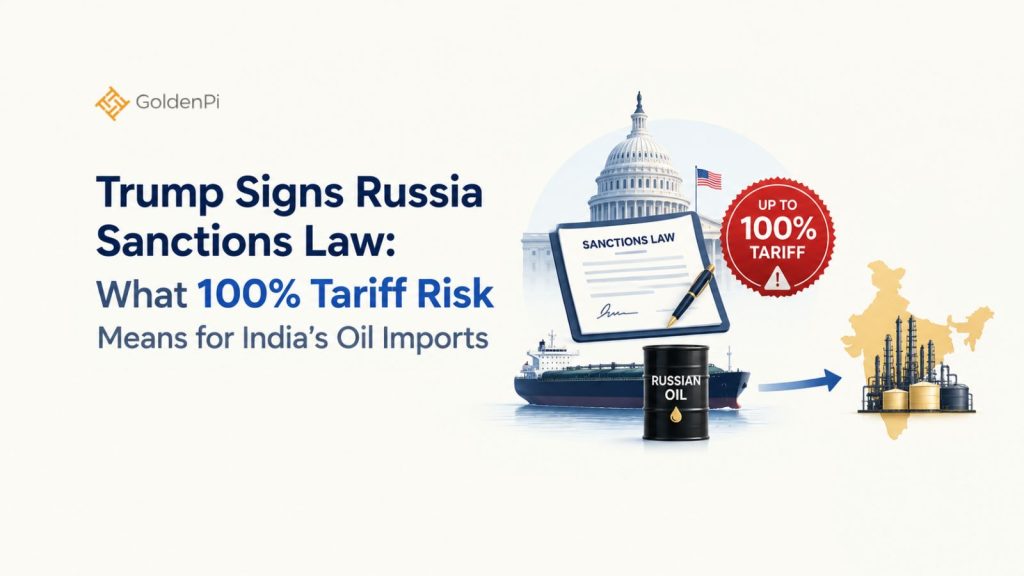
What had been sitting in Congress for over a year is now American law. On September 18, 2026, US President Donald Trump signed the “Lindsey O. Graham Sanctioning Russia and Iran Act of 2026″—a sweeping sanctions package that gives Washington fresh tools to squeeze Russia’s war economy, and by extension, its biggest oil customers. For India, which now sources close to half its crude from Russia, this shifts things from “watch this space” to “this is now the rulebook.”
Start investing with just ₹10K & grow your wealth with fixed return opportunities.
Invest Now

What the New Sanctions Law Actually Does
The Act cleared the House 262-159 on September 16, following the Senate’s 86-11 vote in August, before reaching Trump’s desk. It expands sanctions on Russian officials, banks, and the energy sector; targets the “shadow fleet” of tankers used to move sanctioned oil; and extends the Iran Sanctions Act to 2031. Crucially, it hands the US President discretionary authority (not an automatic mandate) to impose tariffs of up to 100% on the top five buyers of Russian crude oil and gas and up to 500% on goods sourced directly from Russia.
Why This Puts India Squarely in the Spotlight
Think of it as a two-tier trigger: the law loads the gun, but the White House decides if and when to pull it, reassessing every 180 days.
| What’s at stake | In plain terms |
| Countries most at risk | China, India, Azerbaijan, Hungary, and Slovakia—the top 5 buyers of Russian oil and gas |
| Highest possible tariff on these countries | Up to 100% on their exports to the US |
| Highest possible tariff on Russian goods directly | Up to 500% |
| Who’s exempt? | Countries buying less than 15% of their gas from Russia and actively cutting that further |
| Tariffs India already pays (since Aug 2025) | 50% total — 25% standard + 25% tied to Russian oil purchases |
| Share of India’s oil imports from Russia | Roughly 46–50% (June–July 2026) |
What Indian Investors and Refiners Should Watch
- Discretionary, not automatic: Trump must actively choose to impose the tariff and can waive it with congressional certification, reviewed every 180 days. So this is a live risk, not a confirmed one.
- Implementation signals to track: Once the USTR (United States Trade Representative) sets a date for its first review (expected within 180 days of the law), that becomes a concrete event to watch. Also worth tracking: how China, which is also a top-5 buyer and a bigger one than India, gets treated first, and any movement in India-US trade talks.
- Refiners already de-risking: State-run refiners scaled back Russian purchases after October 2025 Rosneft-Lukoil sanctions; this law raises the stakes further.
- Shadow fleet costs could bite first: Freight and insurance costs on Russian crude routes may rise well before any tariff lands, since the law directly targets the tanker network.
- Stocks and macro to watch: Reliance, IOC, BPCL, HPCL, and shipping/insurance names for logistics-related moves; Brent and the rupee for any supply-squeeze pressure.
Latest Bond Updates:
- Trump Signs Russia Sanctions Law: What 100% Tariff Risk Means for India’s Oil Imports
- Low-Risk Investment Options in India 2026: Safety, Returns & Tax Efficiency

- All About Recurring Deposits (RDs): The Complete Investor’s Guide
The Investor Takeaway
The law is real now, but nothing forces Trump to actually use the tariff power; that’s still his call. Washington has had similar leverage over India for more than a year and has chosen talks over action so far. This law doesn’t change that pattern. It just makes the option more permanent.
Here’s what’s actually new: this risk can no longer just disappear if a bill fails in Congress. It’s now law, with a built-in review every 180 days. That means it stays on the table indefinitely and becomes a bargaining chip in India-US trade talks, whether or not the tariff is ever used.
For investors, the takeaway is simple: don’t treat this as a one-time event to trade around. Treat it as an ongoing risk to keep an eye on, similar to how markets have gotten used to tariff headlines over the past year without overreacting each time.
Disclaimer
Fixed returns do not constitute guaranteed or assured returns. Investments in corporate debt securities and municipal debt securities/securitized debt instruments are subject to credit risks, market risks, and default risks, including delay and/or default in payment. Read all the offer-related documents carefully. This blog/article should not be construed as financial advice or as an offer or recommendation to buy or sell any security or any products/services of/on GoldenPi or any product/services of its third-party client(s). For a detailed calculation of YTM, visit our website. T&C’s Apply.