|
Getting your Trinity Audio player ready...
|
When the markets get choppy, most investors reach either for gold or bonds. Both are considered safe haven assets, which are instruments that either hold steady or gain value in times when equity is dipping and uncertainty is on the rise. But the relationship between the two goes beyond the simple equation.
In 2026, with gold prices on a global sustained run and India’s benchmark G-Sec yield floating around 7%, understanding how these two assets interact has become a necessity for Indian investors. This article unpacks the nuances and what they mean for you.
Why Gold and Bond Yields Move in Opposite Directions
The most important correlation that surfaces every now and then is that gold prices and bond yields generally move inversely.
When bond yields rise, they offer better returns than holding gold for the same duration. This is because gold pays no interest, and the only returns you get are the differences in the purchasing and selling prices. This motivates investors to pivot from gold to bonds, pushing gold prices down.
Conversely, when bond yields fall, the equation flips. Bonds offer less than the market rates, which makes gold’s lack of yield more insignificant and turns investors’ heads towards it.
The underlying force in this dynamic is the real interest rate, which is defined as the nominal bond yield minus inflation. When real rates are high, the opportunity cost of holding gold grows; when real rates are low, gold becomes the more rational choice as a result of inflation eating into your bond returns.
Start investing with just ₹10K & grow your wealth with fixed return opportunities.
Invest Now

How Gold Prices Affect Government Bond Yields in India
The gold-yield inverse is most consistent with government securities. When gold rises sharply, it often signals that investors are factoring in inflation, geopolitical stress, or economic slowdowns. All three of these scenarios tend to push G-Sec yields in specific directions. Gold watchers who also hold G-Secs should focus on why gold is rising and not just that it is.
In India’s current environment, with the 10-year G-Sec yield touching and staying around 7% and gold riding high, both assets demand an investor’s attention.
Related Post:
- SGB Discontinued: 5 SGB Alternatives to Invest in Gold in 2026

- Best SGB Alternatives in 2026: Gold ETFs, Funds & More

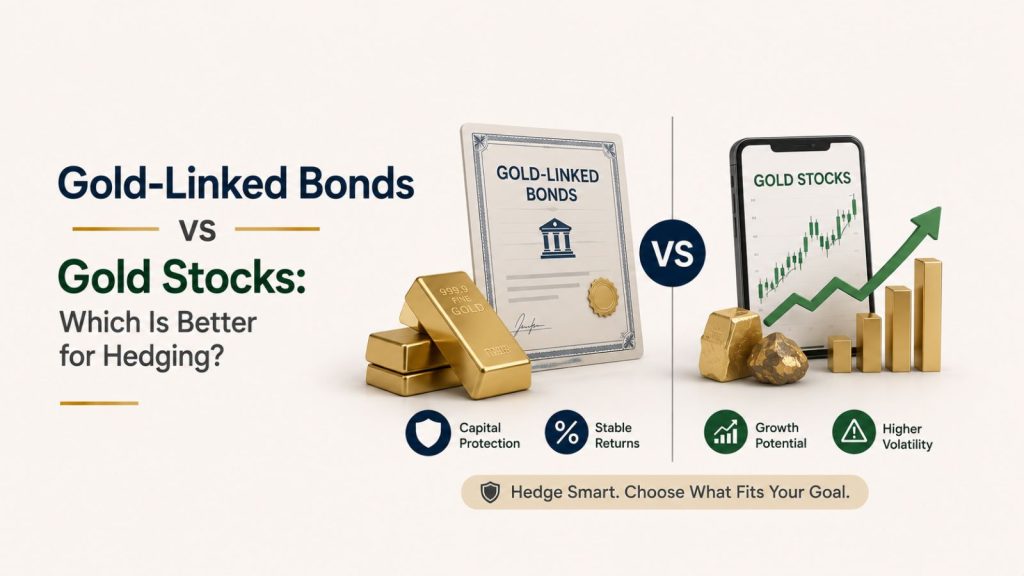
- Gold-Linked Bonds and Portfolio Hedging: When Gold Debt Beats Gold Mining Stocks
How Rising Gold Prices Impact Corporate Bonds
When gold prices surge due to uncertainties in the global environment, corporate bonds typically face pressure from two directions:
- First, investors demand higher yields to compensate for the higher credit risk, which leads to a fall in corporate bond prices.
- Second, credit spreads widen: The gap between government yields and corporate bond yields increases.
To put it simply, a gold rally is usually bad news for corporate bonds, especially the lower-rated ones. The riskier the issuer, the more the bond suffers. This is why credit spreads are worth tracking alongside gold prices.
Why High-Yield Bonds Feel the Most Impact
High-yield bonds have the most sensitive inverse relationship with gold during such episodes.
High-yield bonds are priced on the assumption that the economy keeps moving, companies keep generating cash flows, and defaults remain in control. When gold surges, all three of these come into question. As a result of the resultant panic, investors are urged to exit high-yield bonds quickly, which causes the credit spread to widen further and the prices to fall sharply.
The insight: If you hold any high-yield bonds during a time when gold is rising based on fear rather than inflation, it should be treated as a signal that you should review the credit quality of your holdings and how easy the exit is.
When Gold and Bonds Rise Together: The Flight to Safety
During periods of acute economic stress, gold and government bonds can rise simultaneously, leading investors to focus their capital on both, abandoning equities and riskier assets across their portfolios.
This dynamic is important to understand because it means the gold-bond relationship isn’t always inverse and might depend on the market’s pulse. In normal market conditions, the inverse relationship holds true. But in times of ambiguity, G-Secs and gold can move hand in hand while corporate bonds move in the opposite direction. Having a good read on the current scenario is key to interpreting what the price movements are actually telling you.
Gold as an Inflation Hedge: What it Means for Bonds
Gold has a reputation for being a great anchor in times when a currency might be facing trouble. Here’s how a rise in inflation affects different bonds:
- G-Secs: Existing bonds lose value while yields on new issuances rise
- Floating rate bonds: Less affected, since coupons move with the benchmark
- Corporate bonds: Face pressure from higher yields and potential downfall in the issuer’s financial performance
- High-yield bonds: Most affected, as inflation can squeeze margins and increase default risk
Gold, on the contrary, tends to perform well across these segments, making it a viable resort during inflationary periods regardless of what the broader bond market feels like.
Recent Post:
- Post Office FD Rates 2026 Explained: Tenures, Quarterly Compounding, and Annual Payouts
- How to Buy Dollar Bonds in India: GIFT City IFSC Guide for Investors
- NCD Allotment in Oversubscribed Issues: Day 1 Priority vs. Pro-Rata
India, Gold, and Bonds in 2026
India’s gold is almost entirely imported, and hence all domestic gold prices are influenced by three things simultaneously: gold prices around the world, the price of the US dollar, and the price of the Indian rupee. When the rupee weakens, gold tends to rise even when international prices remain unchanged and almost invariably represents the type of macroeconomic uncertainty that creates a demand for safe-haven assets like G-Secs, while at the same time, corporate and high-yield bonds face pressure. It is important to pay attention to currency movements along with gold prices and credit spreads.
In this context, Sovereign Gold Bonds emerge as the most graceful solution to the gold-bond equation in India. They provide sovereign safety, upside potential from the gold price, a 2.5% annual coupon payment, and tax-free redemption on maturity—combining the best of both asset classes all in one. As an Indian investor in 2026, SGBs are far from just being the compromise choice between gold and bonds. They argue that ultimately, the two do not have to be mutually exclusive.
Frequently Asked Questions
A: In general, gold prices and the yields of government bonds move in inverse directions, although, during a crisis, the prices of bonds could also increase while buyers rush to gold as representative of the “safe” category of assets. When the fear of a gold rally takes hold, the typical pattern for corporate or high-yield bonds is reduced prices and increased spreads.
A: Gold doesn’t generate interest. As real rates approach zero (or become negative), the opportunity cost of gold is reduced considerably. With low to non-existent real returns on bonds, holding gold can be advantageous.
A: When gold is on the rise because of risk-off conditions, usually spreads on corporate bonds also widen; that is, the bonds decline in price as investors require higher yields to offset the risk of owning the corporate bond. This is particularly true for lower-rated bonds and less so for higher-rated investment-grade bonds.
A: SGBs are government bonds with a fixed principal tied to gold prices, plus a 2.5% annual coupon and capital gains tax exemption upon maturity (if purchased at the time of original issuance). They are unique because they have the characteristics of a G-Sec that are combined with the price upside of gold, thus making them relevant to both bond and gold investors.
Ready to Invest?
Visit GoldenPi to explore current bond options. Compare yields, ratings, and tenures in one place and invest online with as little as ₹10,000.
Disclaimer:
Fixed returns do not constitute guaranteed or assured returns. Investments in corporate debt securities, municipal debt securities/securitized debt instruments are subject to credit risks, market risks and default risks, including delay and/or default in payment. Read all the offer-related documents carefully. This blog/article should not be construed as financial advice or as an offer or recommendation to buy or sell any security or any products/services of/on GoldenPi or any product/services of its third-party client(s). For a detailed calculation of YTM, visit our website. T&C’s Apply.