With the RBI holding the repo rate at 5.25% through 2026 so far and banks lowering their fixed deposit rates in response, conservative investors are finding it difficult to find low-risk investment options with meaningful post-tax returns. However, there are options that prove safety and yield don’t necessarily have to be mutually exclusive.
This article will look into them (government securities, RBI bonds, deposits, and corporate bonds) while also talking about how and to what extent these investments are taxed, because that’s usually where the real return gets decided.
Start investing with just ₹10K & grow your wealth with fixed return opportunities.
Invest Now

What “Low-Risk” Really Means in Today’s Market
It helps to separate capital safety from return stability. A sovereign-guaranteed instrument like PPF has near-zero default risk but still might struggle with inflation. An NBFC deposit or debt fund carries some credit risk, usually minimal if you stick to high-quality issuers. None of these guarantee returns the way a bank deposit’s principal is insured, so treat any product marketed with “assured” returns as a red flag, not reassurance.
Government-Backed Small Savings Schemes and POTDs
These remain the most trusted options, backed by the Government of India. Current rates (July–September 2026 quarter):
- PPF: 7.1%, 15 years, fully tax-exempt (EEE)
- SSY: 8.2%, for a girl child’s future, fully tax-exempt
- SCSS: 8.2%, 5 years, interest fully taxable
- NSC: 5-year maturity. The investment and eligible accrued interest can qualify for the ₹1.5 lakh deduction under Section 123 of the Income-tax Act, 2025, subject to the applicable conditions; the interest is otherwise taxable
- Post Office Time Deposit (POTD): 6.9%–7.5% across 1–5 year tenures, with quarterly compounding. Interest is taxable, while deposits in a 5-year Time Deposit can qualify for the Section 123 deduction, subject to the applicable conditions
The headline rate isn’t what matters for a taxpayer. SCSS pays 8.2%, but post-tax, an investor in the 30% tax bracket would receive 5.7% (approx.), making SSY (which pays 8.2% and is tax-exempt) a better scheme for them. An investor should always consider their tax slab before making a decision regarding the “best” scheme.
| Instrument | Current Rate | Tenure | Tax Treatment |
| PPF | 7.1% | 15 years | Interest and maturity proceeds are generally tax-exempt. |
| SSY | 8.2% | 21 years from account opening | Interest and maturity proceeds are tax-exempt, subject to scheme rules. |
| SCSS | 8.2% | 5 years | Interest is taxable at the applicable rate. |
| NSC | 7.7% | 5 years | Eligible investment/accrued interest can qualify for the Section 123 deduction, subject to conditions; interest is taxable. |
| POTD (5-year) | 7.5% | 5 years | Interest is taxable at the applicable rate; eligible 5-year deposits can qualify for the Section 123 deduction, subject to conditions. |
| RBI Floating Rate Savings Bond | 8.05% (Jul–Dec 2026) | 7 years | Interest is taxable at the applicable rate. |
| High-rated PSU bonds | Varies by issue/yield | Varies | Interest is generally taxable at the applicable rate. |
Source: India Post, MyScheme, RBI
RBI Floating Rate Savings Bonds
The RBI Floating Rate Savings Bond (FRSB) 2020 is a sovereign-backed instrument open to resident individuals and HUFs, with a minimum investment of ₹1,000 and no upper cap. Its coupon resets every six months, linked to the then-current NSC rate plus a fixed 0.35% spread. This means your return moves with the rate cycle rather than locking in for the full seven-year tenure, which helps if rates rise but also means it isn’t a fixed number the way many investors assume. Interest is paid out semi-annually rather than compounded, so it suits income-seekers more than pure compounders. There’s no premature exit except for senior citizens under specific conditions, and interest is fully taxable at the slab rate.
High-Rated Corporate and PSU Bonds
For a yield edge over government schemes without straying far from safety, high-rated (AAA, sometimes AA+) bonds are worth a dedicated look. A few routes in:
- Direct bonds via Online Bond Platform Providers (OBPPs): SEBI-registered platforms let retail investors buy listed bonds of PFC, REC, NHAI, etc., and earn yields in the range of 7%-8%, depending on the issuer and tenor.
- Bharat Bond ETFs / FOFs: Invest exclusively in AAA-rated PSU bonds with a fixed target-maturity structure; essentially a ready-made bond ladder. The current series runs through 2030–2033 maturities.
- State Development Loans (SDLs), G-Secs, and Treasury Bills: Available directly via RBI Retail Direct, carrying sovereign or near-sovereign safety. T-Bills (91/182/364-day) suit very short-term parking of surplus cash, while SDLs and G-Secs work for longer tenors.
A word of caution: Bharat Bond ETF units bought after April 1, 2023, no longer get indexation and are taxed at slab rates like other debt funds. A AAA rating today doesn’t eliminate the possibility of a downgrade tomorrow; “predictable” isn’t “guaranteed.”
Latest Bond Updates:
- Low-Risk Investment Options in India 2026: Safety, Returns & Tax Efficiency
- All About Recurring Deposits (RDs): The Complete Investor’s Guide
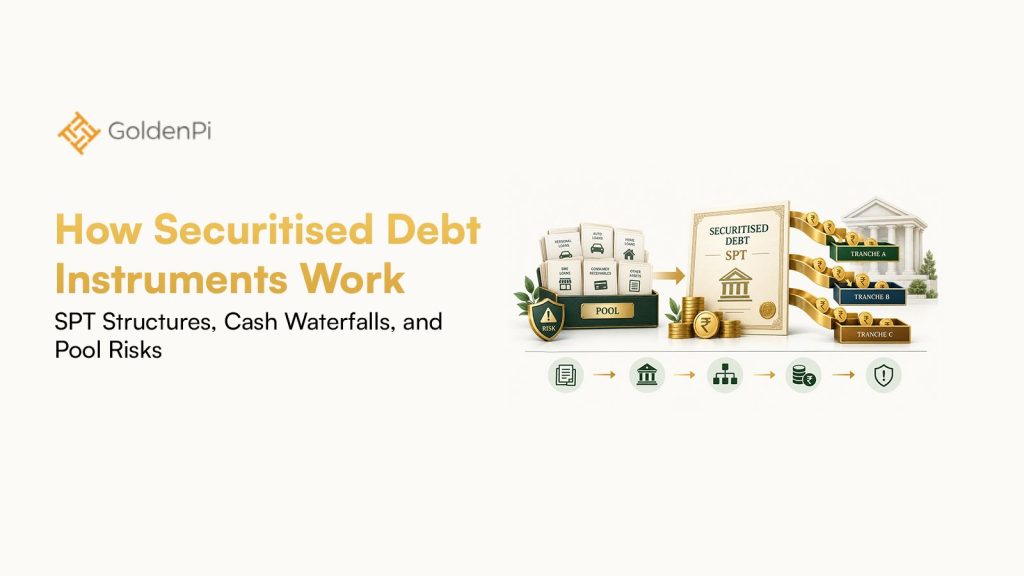
- Securitised Debt Instruments Explained: SPTs, Cash Waterfalls & Pool Risks
Debt Mutual Funds: The Tax Rules Have Changed
Debt funds are used to offer safety and tax efficiency via indexation on long-term capital gains. These features no longer apply. As per the Finance Act 2023, capital gains on debt funds, bought on/after 1st April 2023, will be taxed at slab rates irrespective of holding period. This makes debt funds comparable to a bank FD in taxation, but with the advantage of liquidity and diversification.
Bank FDs, NBFC/HFC Deposits, and POTDs: Who Wins After Tax?
- Bank FDs: 1-year rates are now mostly in the 6–6.75% range; TDS applies above ₹50,000 interest (₹1 lakh for seniors).
- NBFC/HFC fixed deposits (AAA-rated): Typically offer 50-150 bps over bank FDs, but carry issuer-specific credit risk and no DICGC cover.
- POTDs: Sovereign-backed, like small savings schemes, with rates broadly comparable to bank FDs, making them a reasonable middle ground for risk-averse savers wanting deposit-style products without issuer risk.
A Note on Sovereign Gold Bonds
SGBs offered investors an option to hold gold in a simple, safe, and tax-efficient manner where capital gains were fully tax-exempt on maturity. But no fresh tranches have come since February 2024, and the Finance Ministry has confirmed that the scheme is effectively discontinued for fresh subscriptions. Existing bondholders are unaffected and can hold to maturity, but this is no longer an option for new low-risk allocations. Gold ETFs or gold mutual funds are the closer substitutes today, taxed differently and without the earlier SGB tax exemption.
Where Regulation Is Heading
SEBI floated a consultation paper in August 2026 proposing tighter advertising norms for Online Bond Platform Providers: mandatory risk warnings wherever “fixed returns” language is used, standardised disclosure of yield-to-maturity and credit ratings, and restrictions on unverified claims like “high yield.” This is still at the consultation stage, but it’s a useful reminder that any debt instrument, however safely marketed, carries market, credit, and default risk, and returns are never guaranteed.
How to Build a Low-Risk, Tax-Efficient Investment Portfolio in India
There’s no single “best” low-risk instrument; only the best fit for your tax bracket, goals, and time horizon. A reasonable way to think about sequencing:
- Start with tax-free, long-term goals: Investments for retirement and/or children’s goals could be made in Public Provident Funds (PPF) and Sukanya Samriddhi Yojana (SSY). These schemes enjoy the EEE (Exempt-Exempt-Exempt) status, meaning the interest earned is completely tax-free.
- Layer in taxable income instruments next: SCSS, POTDs, or RBI Floating Rate Bonds work well for near-term or regular income needs, particularly for retirees or anyone in a lower tax bracket.
- Add some issuer risk for better returns and diversify: For this, high-rated corporate bonds, Bharat Bond ETFs, or AAA-rated NBFCs/HFCs are good. But this should be a very small part of your low-risk portfolio, as the main focus of this category is capital safety.
- Use debt funds for liquidity, not tax arbitrage: Their biggest advantage vs FDs in the post-2023 tax regime is no TDS on redemption and flexibility, not a lower effective tax rate.
The best mix depends on several factors, including your tax slab, liquidity needs, and how much issuer-specific risk you’re willing to carry for an extra percentage point or two of yield. This article is for general information only and isn’t investment advice; individual tax situations and risk appetites vary, so it’s worth running your specific numbers past a SEBI-registered financial advisor before acting on any of this.
Low-Risk Investment Frequently Asked Questions
No. The term “low risk” does not mean zero risk. Different products carry different risks, including credit, interest rate, liquidity, inflation, and reinvestment risk.
Government of India securities are generally considered to have no domestic sovereign credit risk. However, investors who sell before maturity can face market-price fluctuations because bond prices and interest rates can move in opposite directions.
Government-backed small savings schemes are generally viewed as relatively low-risk because they are backed by the Government of India under their respective scheme frameworks. Their interest rates and conditions are notified by the government and can change for new investment periods.
Yes. Even if the nominal value of an investment does not fall, inflation can reduce its purchasing power. An investment earning 6% when inflation is 5% provides a much smaller real return than the headline rate suggests.
Real return is the return after accounting for inflation. A simple approximation is Real return ≈ Nominal return − Inflation
For example, a 7% nominal return during 5% inflation is roughly a 2% real return before considering tax.
Over particular periods, some fixed-income products can have attractive nominal returns, but they should not be compared with equity purely on the basis of the highest observed return. Equity carries substantially different levels of market risk and return potential.
Disclaimer
Fixed returns do not constitute guaranteed or assured returns. Investments in corporate debt securities and municipal debt securities/securitized debt instruments are subject to credit risks, market risks, and default risks, including delay and/or default in payment. Read all the offer-related documents carefully. This blog/article should not be construed as financial advice or as an offer or recommendation to buy or sell any security or any products/services of/on GoldenPi or any product/services of its third-party client(s). For a detailed calculation of YTM, visit our website. T&C’s Apply.