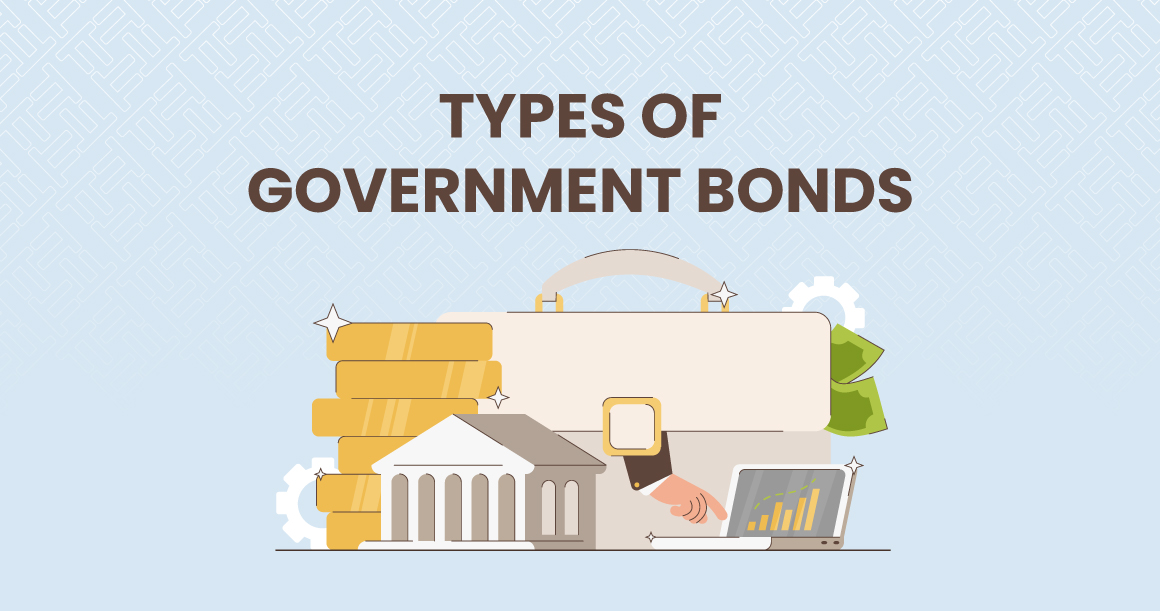
When building a fixed-income portfolio, understanding the various types of government bonds available in India is an important first step. Government securities, commonly referred to as G-Secs, are debt instruments issued by the government to manage fiscal deficits and fund nationwide developmental initiatives. Backed by the sovereign authority of the country, these instruments represent some of the most stable debt options available in the Indian financial market.
In this guide, we break down how govt bonds operate, detail the primary types of bonds available, and analyze key factors to consider when choosing which bonds to buy in May 2026
What are Government Bonds and How Do They Work?
Government bonds are formal debt contracts. When you invest in these securities, you lend capital to either the Central Government of India or individual State Governments. In exchange, the issuing authority promises to pay periodic coupon (interest) payments and return the principal amount upon maturity
Because these instruments are backed by sovereign commitment, they carry negligible credit risk. Investors looking for secured gov bonds should note that government-issued bonds do not require physical collateral or asset backing; rather, they are backed by the taxing and revenue-generating power of the issuing sovereign
Start investing with just ₹10K & grow your wealth with fixed return opportunities.
Invest Now

Core Bond Market Data (May 2026)
To ensure full transparency under SEBI’s Online Bond Platform Provider (OBPP) guidelines, the table below provides the core metrics for representative government securities and State Development Loans (SDLs) actively traded in the secondary market
| Issuer Name | Tenor / Security | Credit Rating (with Agency) | Nature (Secured/Unsecured) | Yield to Maturity (YTM) |
| Government of India | 5 Years (6.36% GS 2031) | Sovereign (Unrated by domestic agencies due to sovereign backing) | Unsecured (Sovereign Backing) | 6.86% |
| Government of India | 9 Years (6.48% GS 2035) | Sovereign (Unrated by domestic agencies due to sovereign backing) | Unsecured (Sovereign Backing) | 7.02% |
| State Government of Rajasthan | 5 Years (7.43% RJ SGS 2031) | Sovereign (Unrated by domestic agencies due to sovereign backing) | Unsecured (Sovereign Backing) | 7.43% |
| State Government of Uttar Pradesh | 12 Years (7.57% UP SGS 2038) | Sovereign (Unrated by domestic agencies due to sovereign backing) | Unsecured (Sovereign Backing) | 7.67% |
For detailed calculation of YTM, please visit our website YTM Calculation.
What are the Five Types of Bonds?
o understand the broader fixed-income landscape, it helps to answer a common investor question: What are the five types of bonds? While government securities form the bedrock of capital preservation, the entire Indian fixed-income ecosystem is broadly categorized into five segments:
- Government Securities (G-Secs): Issued by the Central Government to fund national infrastructure and public expenditure. These carry the highest credit safety.
- State Development Loans (SDLs): Issued by individual state governments to meet their respective budgetary requirements and development plans.
- Public Sector Undertaking (PSU) Bonds: Issued by corporate entities where the government holds a majority stake (such as NHAI or REC). These can be taxable or tax-free.
- Corporate Bonds: Debt instruments issued by private sector corporations and Non-Banking Financial Companies (NBFCs) to fund expansion. These are rated by credit agencies (like CRISIL or ICRA) based on repayment capacity.
- Municipal Bonds (Muni Bonds): Issued by local municipal corporations or urban local bodies to finance localized infrastructure projects such as roads, water systems, and schools.
Recent Post:
What are the 4 Types of Bonds Issued by the Government?
When focusing exclusively on sovereign-backed issuances, investors often ask: What are the 4 types of bonds under the government umbrella? The four primary government securities available to retail investors in India are
1. Treasury Bills (T-Bills)
Treasury Bills are short-term debt instruments issued only by the Central Government. They do not pay periodic interest. Instead, they are zero-coupon bonds issued at a discount to their face value and redeemed at par upon maturity. In May 2026, standard secondary market yields across key tenors are
- 91-Day T-Bill YTM: ~5.52%
- 182-Day T-Bill YTM: ~5.75%
- 364-Day T-Bill YTM: ~5.97%
For detailed calculation of YTM, please visit our website YTM Calculation.
2. Dated Government Securities (G-Secs)
These are long-term types of government bonds that offer a fixed or floating interest rate. The interest (coupon) is typically paid out semi-annually. Maturities for G-Secs can range anywhere from 5 years up to 40 years, serving as a cornerstone for long-term institutional and retail portfolios alike.
A. Fixed Rate Bonds
Fixed rate bond’s coupon rate is constant for its entire life as a government obligation. In other words, regardless of changes in market rates, the interest rate stays the same throughout the investment period.
For instance, an investor might purchase a fixed-rate bond from the government with a face value of Rs. 1000 and a coupon rate of 10%. The bond’s term is 10 years, and the payment schedule is either semi-annual or annual. Following that, the investor would get Rs. 50 (5%) every six months and Rs. 100 (10%) every year for the following ten years. While the market rate may fluctuate greatly, the coupon rate on this bond will not change at all.
B. Floating Rate Bonds
Bonds usually have a specified coupon rate or interest rate. However, a floating rate bond, on the other hand, is a type of debt obligation without a fixed coupon rate and instead has an interest rate that changes according to the benchmark from which it is taken. Benchmarks are tools of the market that have an impact on the national economy. Examples of benchmarks for a floating rate bond are the repo rate and the reverse repo rate.
You might have got confused now, about how this is going to work out – don’t worry let us illustrate with an example.
- Bond Price Rs. 1000
- Quoted margin – 4% (It will not change the entire tenure of the bonds)
- Liable – 6 months
- Liable rate – 1%
- Tenure – 2 years
Then the investor gets the following after the six months
4% (quoted margin) + 1% liable rate at the time of purchase = Rs.50
Since every six months’ the liable rate changes, if it increases to 2%
Then the investor will receive it after one year –
4% (quoted margin) + 2% liable rate since it is reversed = Rs.60 Most of the bonds also will come up CAP which means – the coupon rate can go a maximum of 6%, not beyond that.
For example, Coupon rate is 5 % and the liable rate is 1.5 % then it is 6.5%. It cannot be paid to the investors because the CAP rate is 6%, it should not go beyond. Therefore, the investors will only receive 6% irrespective of the liable rate changes.
C. Capital Indexed Bonds
Bonds known as “Capital Indexed Bonds” (CIBs) have periodic adjustments made to their capital value and interest payments to account for fluctuations in the Consumer Price Index (CPI). Typically, a fixed rate of interest is charged on the recalculated face value. Investors receive the bond’s adjusted face value along with the final coupon calculated from the modified face value when the bond matures.
D. Inflation Indexed Bonds
Inflation Index bonds (IIBs) are where the principal amount and the interest payment are linked to an inflation index. The Consumer Price Index (CPI) or the Wholesale Price Index may be used as an indicator of inflation. Investing in these bonds ensures steady real profits. Additionally, it might protect the investor’s portfolio from inflation rates.
For example.
Governments issue Inflation Index bonds
Bond price – R.1000
The interest rate or coupon rate – CPI (The consumer Price Index) + 5%
Here the interest rate of 5% would remain constant and CPI may change based on inflation.
Tenure – 5 years
Payment – Semi-Annually
At the end of the 6 months if the inflation is 8 % then the investor would be receiving
= 8 % + 5 % = 13%
= Rs.130
At the end of the year if the inflation is 6% then the investors would be receiving
= 6 % + 5 % = 11 %
= Rs.110
Must Read: How does Inflation Affect Bond Price?
E. Bonds with Call or Put Option
These bonds include a call option that gives the issuer the opportunity to repurchase the bond or a sell option that gives the investor the option to sell the bond to the issuer (put option). Only five years after the date of issue will the investor or issuer be able to exercise their rights.
Example
- Bond Price – Rs. 1000
- Tenure – 10 years
Government can buy back the same bond at the same price Rs. after the completion of 5 years before the maturity period (10 years). If only the government wants to re-purchase the bond.
In the same way, the investors can sell the bond to the government at the same price which they had purchased five years before.
F. Special Securities
The Government of India also occasionally issues special securities to companies like Oil Marketing Companies, Fertilizer Companies, the Food Corporation of India, etc. under the market borrowing program as payment in place of cash subsidies. These securities are known as oil bonds, fertilizer bonds, and food bonds, respectively. These securities are often long-dated and have a little larger coupon than the yield of similarly dated assets with a similar maturity.
Example companies – Indian Oil, Hindustan Fertiliser Corporate limited,
G. STRIPS – Separate Trading of Registered Interest and Principal of Securities
Separate Trading of Registered Interest and Principal of Securities is referred to as STRIPS. Here, a fixed-rate bond’s cash flow is transformed into separate security. The secondary market is where they are traded after that. Additionally, they resemble zero-coupon bonds in many ways. They are made from the securities that already exist, though.
I’m sure you might be confused with the definition of STRIPS. Let us understand with an example.
- Bond price Rs.1000
- Coupon rate – 10 %
- Tenure – 5 years
- Payment mode- Semi-Annually
Now let’s apply the STRIPS concept- since it’s a 5-year bond and the payment period is semiannual; the bonds will be stripped into 10 semiannual coupons and each coupon will be treated as a standalone coupon bond. The final payment of the principal payment also will be treated as a standalone zero-coupon bond.
Here the investor either can trade the coupon rate or principal amount separately
H. Sovereign Gold Bonds (SGB)
We are so dramatically attached to its physical gold, but Sovereign Gold bond (SGB) online issued by the government. The best part is the interest on these bonds falls under tax exemption for individual taxation.
Minimum investment in the Bonds shall be one gram with a maximum limit of subscription per fiscal year of 4 kg for individuals, the nominal value of the bonds will be determined in Indian Rupees using the three last working days of the week before the subscription period’s simple average closing price of gold with a purity of 999.9, as announced by the India Bullion and Jewelers Association Limited.
For investors applying online and making a payment in response to their application via digital means, the issue price of the Gold Bonds will be Rs. 50 per gram less than the nominal value.
The Bonds will accrue interest at a fixed rate of 2.50 percent (annually) on the nominal value.
The last interest payment will be due along with the principal at maturity and will be made in half-yearly installments.
Must Read: What is Sovereign Gold Bond?
I. Zero Coupon Bonds
The majority of bonds give monthly, quarterly, semiannual, or annual interest based on the coupon rate; but zero-coupon bonds do not have any such interest. With a zero bond, you purchase the bond at a discount from its face value and are paid the face amount when the bond expires rather than receiving interest payments.
Let us take an example.
- The actual face value –Rs. 10000
- You buy it at a discount price – Rs 7000
- Tenure or lock-in period – 5 years
At the end of the five years, you will receive Rs. 10000 (which was the face value of the bond while you were purchasing)
This situation can vary if the market fluctuates, and the face value can be lesser than the purchase price.
Let us take an example.
- The actual face value –Rs. 10000
- You buy at a discount price – Rs 7000
- Tenure or lock-in period – 5 years
At the end of the five years, if the same bond is trading at Rs. 6500 then you will receive only Rs. 6500 due to the market fluctuation.
You can also sell the same bond before maturity in the secondary market. The face value can depend on the again the market condition. It can be sold at a discount price or a higher price.
Related Post:
- Step Up Bonds in India: Meaning, How They Work, and Should You Invest?
- India’s Bloomberg Bond Index Inclusion: What It Means For Retail Investors
- Municipal Bonds in India: What Retail Investors Should Know Before Investing
3. State Development Loans (SDLs)
SDLs are govt bonds issued by individual state governments rather than the central authority. While they carry a similar sovereign risk profile due to RBI management, states borrow at yields that reflect their individual fiscal health. This typically results in SDLs offering a higher yield (often 50 to 80 basis points higher) compared to corresponding Central G-Secs.
4. Sovereign Gold Bonds (SGBs)
SGBs are government securities denominated in grams of gold. They offer a practical alternative to physical gold investment. SGBs pay a fixed nominal interest rate (typically 2.50% per annum on the initial investment value) and are structured to mature after 8 years, with capital gains fully tax-exempt if held until maturity
5. Cash Management Bills (CMBs)
In the Indian financial sector, cash management bills are new securities. This security was first made available in 2010 by the Indian government and the Reserve Bank of India. Cash management bills are issued to cover short-term inconsistencies in the government of India’s financial flow.
The RBI issues the billson behalf of the government. Treasury bills and cash management bills are both short-term securities that are issued when necessary. However, the main distinction between the two is the maturity period CMBs are an extremely short-term investment option because they are issued with maturity duration of fewer than 91 days.
For instance, if a Cash management bill has a face value of Rs.50, we can purchase it for Rs. 45 and receive Rs. 50 at end of the maturity period, which is typically 60 days. Due to the short maturity period, there is no interest payment in this case. However, a discount is received as payment for purchasing the Cash Management bill.
Key Considerations When Selecting Bonds to Buy
When evaluating bonds to buy, matching the asset’s features with your financial profile is essential. Keep these parameters in mind:
- Yield to Maturity (YTM): Always evaluate the YTM rather than focusing solely on the coupon rate. YTM accounts for the bond’s current market price, coupon payments, and the time remaining until maturity.
- Investment Tenor: Ensure the maturity of the G-Sec or SDL aligns with your liquidity needs, as selling bonds in the secondary market prior to maturity exposes you to interest rate fluctuations.
- Taxation: Interest income earned from Central G-Secs and SDLs is fully taxable according to your applicable income tax slab rates.
Closing Thoughts
It’s significant to have a better option for your portfolio because Government issues a wide variety of government securities. You can select the G-Sec that best fits your investment timeline because tenure is one of the key distinctions from other instruments. Government bonds or G-sec not only provide assurance of better returns and comes with less risker than other types of bonds.
Types of Government Bonds FAQ’s
Callable bond can be redeemed by the issuer before it’s maturity date. They are typically issued with a face value and a maturity date, at which point the bonds can be redeemed for the face value
The minimum amount to invest in savings bons is Rs 1000 and in multiples thereof.
Government bonds in India are not tax free. However, the interest earned on these bonds is exempt from tax. This means that you will not have to pay any tax on the interest you earn from investing in government bonds. For example, interest on certain municipal bonds may be exempt from federal and state taxes. Capital gains from the sale of government bonds are also generally taxable.
Bonds are fixed-income investments where you lend money to an entity (a company or government) that borrows the funds for a defined period at a variable or fixed interest rate. Bonds are classified primarily by their issuer and unique structural features
1. Government Bonds
2. Corporate Bonds
3. Municipal Bonds
4. Zero Coupon Binds
5. Convertible Bonds
The “best” government bonds depend on your financial goals. In India, sovereign-backed instruments offer distinct advantages for safety, tax benefits, or higher yields:
1. RBI Floating Rate Savings Bonds
2. Sovereign Gold Bonds (SGBs) – Discontinued
3. Section 54EC Bonds
4. State Government-Guaranteed Bonds
5. Central Government Dated Securities
Yes, you can buy government bonds (G-Secs) directly. In India, retail investors can bypass intermediaries and access government securities, Treasury Bills (T-Bills), and State Development Loans (SDLs) through three primary channels
Ready to Invest?
Visit GoldenPi to explore current bond options. Compare yields, ratings, and tenures in one place and invest online with as little as ₹10,000.
Disclaimer:
Fixed returns do not constitute guaranteed or assured returns. Investments in corporate debt securities and municipal debt securities/securitized debt instruments are subject to credit risks, market risks, and default risks, including delay and/or default in payment. Read all the offer-related documents carefully. This blog/article should not be construed as financial advice or as an offer or recommendation to buy or sell any security or any products/services of/on GoldenPi or any product/services of its third-party client(s). For a detailed calculation of YTM, visit our website. T&C’s Apply.